

Health consists with temperance alone.
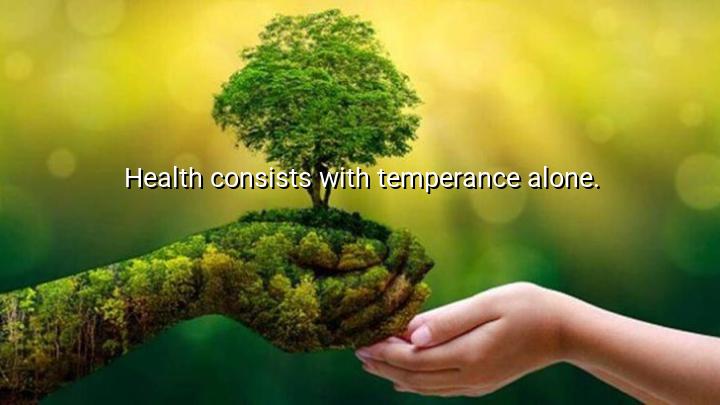




The quote "Health consists with temperance alone." by Alexander Pope emphasizes the importance of moderation and self-control in maintaining health. Pope, an 18th-century English poet known for his satirical verse and moral philosophy, asserts that true health is not achieved through extreme actions or indulgence but through a balanced and measured approach to life. Temperance, the practice of avoiding excess in all things, is presented as the key to both physical and mental well-being.
Pope's statement reflects his belief that excess—whether in food, drink, or behavior—leads to disorder and illness. In his time, the idea of moderation was central to many moral and philosophical systems, including the concept of a well-balanced life. By advocating for temperance, Pope suggests that health is not just about the absence of disease, but about living in a way that nurtures both the body and the mind.
The idea of temperance in Pope’s quote also connects to broader ideas of moral and emotional balance. Pope often explored themes of virtue, reason, and self-discipline in his work, and this quote reinforces the notion that true health is a result of inner harmony. By exercising control over one's desires and actions, a person can achieve not only physical health but also mental clarity and moral integrity.
Ultimately, Pope's quote advocates for a life where moderation is key. It suggests that by practicing temperance—the deliberate choice to avoid excess—individuals can maintain balance, well-being, and long-lasting health, rather than relying on extremes or indulgences that could lead to harm. The idea is timeless, resonating with modern perspectives on healthy living and the importance of balance in every aspect of life.

BRBanana Remix
This makes me think about balance in all things and whether temperance applies equally to mental health, relationships, and lifestyle choices. Is moderation always the best path, or are there times when indulgence or intensity is necessary for growth and fulfillment? How do we find the right measure of temperance for our unique lives?
TPThuy Pham
Emotionally, the idea of temperance as a key to health feels both empowering and challenging. It suggests personal responsibility, but might also imply guilt if one’s health falters. How can we encourage temperance without shaming individuals? What role do societal and systemic factors play in supporting or hindering people’s ability to live temperately?
AVNguyen Anh Vinh
I wonder about the cultural and historical context of this idea. In Pope’s time, temperance was often linked to moral and social virtues. Does this connection still hold today, or has the meaning shifted? How do different cultures interpret temperance, and what impact does that have on their collective health practices and attitudes?
YNY Nhu
This quote seems to simplify health into one principle—temperance. But is health really that straightforward? How do genetics, environment, and healthcare play into this equation? Could temperance be the foundation, but not the entire picture? I’d be interested in perspectives on how modern medicine complements or contrasts with this classical view of health.
ANAT N
Alexander Pope’s assertion that health depends solely on temperance prompts me to think about how moderation influences physical and mental well-being. Is temperance about diet alone, or does it extend to all aspects of life, such as emotions and habits? In today’s fast-paced world of excess, how practical is it to maintain temperance, and what strategies might help people achieve this balance for better health?