

Happiness is spiritual, born of truth and love. It is unselfish; therefore it cannot exist alone, but requires all mankind to share it.
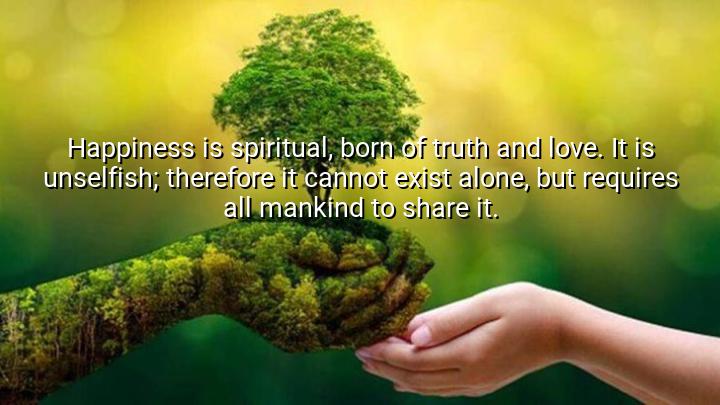




The quote "Happiness is spiritual, born of truth and love. It is unselfish; therefore it cannot exist alone, but requires all mankind to share it." by Mary Baker Eddy emphasizes the spiritual nature of true happiness. According to Eddy, happiness is not merely a fleeting emotion or material possession but a deeper, selfless state that arises from living in alignment with truth and love. It suggests that genuine happiness comes from a connection to higher principles and is rooted in understanding and compassion.
Eddy's perspective underscores that happiness is not an individual pursuit but a collective experience. She asserts that because happiness is inherently unselfish, it cannot thrive in isolation. It requires the participation of all mankind to truly be experienced and shared. This reflects the idea that true joy is found not only in personal fulfillment but also in fostering a sense of community, where the well-being of others is equally valued.
Furthermore, the quote suggests that love and truth are the foundation of happiness. Happiness that is grounded in self-interest or material gain is ultimately shallow, whereas a happiness rooted in spiritual and moral values is lasting and expansive. In this view, happiness is not just an individual experience but a universal force that can bring people together in harmony.
The origin of this quote comes from Mary Baker Eddy, the founder of the Christian Science movement, which emphasizes the power of spiritual healing and the mind-body connection. Eddy’s teachings on spirituality, truth, and love have had a significant impact on how people view health, happiness, and well-being. Her perspective in this quote reflects her belief in the interconnectedness of all people and the idea that happiness is a shared spiritual experience rather than a selfish or material pursuit.

TTLe Trac Thịnh
This idea of happiness being ‘spiritual’ and ‘unselfish’ challenges the idea that it’s primarily a feeling or emotion. Does this mean happiness is more about a way of being or living? How might this understanding change how people pursue happiness in their daily lives? Could it also suggest that individual happiness is deeply linked to the well-being of others?
KPVuong kha phung
I appreciate the connection between happiness, truth, and love here. But I’m curious—does the quote imply that without these elements, happiness is incomplete or even false? How might this view influence how we approach relationships and personal growth? Can happiness be cultivated intentionally through spiritual practice and acts of love?
HHHuynh Hoa
The emphasis on ‘all mankind’ sharing happiness invites reflection on global unity. How realistic is it to think that happiness can be universally shared in a world full of inequality and conflict? What practical steps can individuals or communities take to foster this collective happiness, especially across cultural and social divides?
NYNhu y
This quote raises an intriguing question: if happiness is inherently unselfish and spiritual, how do material comforts and personal achievements fit into that picture? Are they distractions or necessary steps? Could pursuing happiness through selfless love and truth lead to a deeper, more lasting fulfillment than traditional measures of success?
NNPhu Ngoc Nguyen
I find this perspective uplifting yet challenging. It suggests that love and truth are the foundations of happiness, but also that it requires a community to thrive. How do we cultivate such shared happiness in a world often marked by division and competition? What role does empathy play in transforming individual happiness into a collective experience?