

God writes the Gospel not in the Bible alone, but also on trees, and in the flowers and clouds and stars.
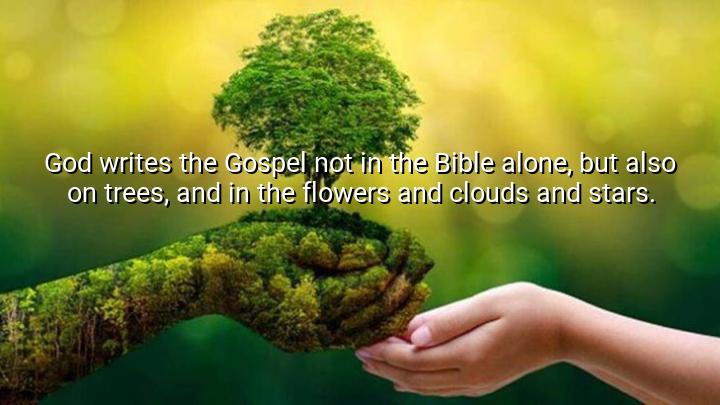




The quote "God writes the Gospel not in the Bible alone, but also on trees, and in the flowers and clouds and stars" is from Martin Luther, a 16th-century German theologian and key figure in the Protestant Reformation. In this statement, Luther emphasizes that the message of God's love and truth is not confined to the pages of the Bible alone, but is evident in the natural world as well. Luther suggests that the Gospel, or divine truth, is revealed through the beauty and wonder of nature, inviting people to see God's presence in all of creation.
Luther’s words reflect the belief in natural revelation, a concept that suggests that God’s creation itself is a form of communication, revealing divine principles to anyone who is willing to observe it. By pointing to trees, flowers, clouds, and stars, Luther highlights how nature can serve as a reflection of God’s glory and wisdom, making divine truths accessible to all, regardless of literacy or religious tradition. This concept encourages people to find spiritual meaning and divine beauty in the world around them.
The statement also implies that God’s message is universal and all-encompassing, present not just in scripture but in the everyday experiences of life. The Gospel is not something that only exists in sacred texts, but in the very fabric of existence, seen in the intricate details of the natural world. Luther encourages a more holistic view of spirituality, one that includes both sacred texts and the observation of the world around us.
In essence, Luther’s quote suggests that divine wisdom and spiritual truths are not limited to religious teachings but are also woven into the fabric of nature. By recognizing this, individuals can experience a deeper connection to the Gospel and God’s presence, seeing His work in both the written word and in the everyday wonders of the world around them. This view expands the reach of faith and invites people to see spirituality in a broader, more inclusive way.

TVNguyen Thi Van
This quote opens up such a gentle but profound way of thinking. It makes me wonder if we’ve overcomplicated the idea of connection with God. Could it be that sitting under a tree or watching the stars is just as sacred as a sermon? And if so, how might our faith journeys shift if we embraced more silence, stillness, and time in nature?
NTHang Nguyen Thi
There’s something timeless and universal about this quote. It suggests that the divine isn’t only found in scripture but in the everyday and the overlooked. But I can’t help but wonder—if nature speaks of God, does our environmental neglect also reflect a spiritual disconnect? Are we, in a way, erasing part of the Gospel by destroying the natural world?
BHcao ba ha
It’s fascinating to hear such a view from a theological figure like Martin Luther. It feels almost mystical. I wonder, does this imply that divine truth is accessible to everyone, even outside organized religion? Could this be a bridge for people who feel spiritual but not religious—those who see beauty and meaning in the world without necessarily reading sacred texts?
LBMai Le Ban
This perspective from Luther is poetic and powerful. It makes me think about how much wisdom and wonder we overlook when we reduce spirituality to doctrine alone. Do you think this viewpoint encourages a more holistic form of faith—one that includes awe, observation, and connection with the earth as part of spiritual practice?
KNLe Thi Kim Ngan
I find this quote deeply comforting. It suggests that spirituality isn’t confined to institutions or books—it’s woven into everything around us. But I do question: if God’s message is so visible in nature, why do we spend so little time paying attention to it? Maybe we’ve become too distracted by our digital lives to hear what creation is quietly saying.