

God employs several translators; some pieces are translated by age, some by sickness, some by war, some by justice.
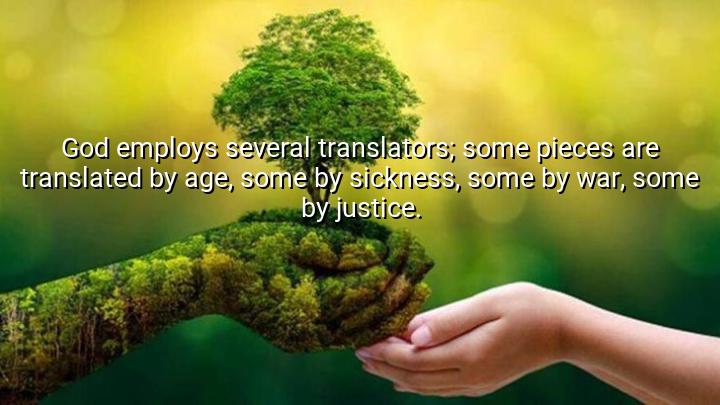




In this quote, John Donne, an English poet and cleric, explores the idea that God uses different means or "translators" to communicate and shape human lives. He suggests that life’s experiences, such as age, sickness, war, and justice, can serve as tools for personal transformation and understanding. Donne implies that through these often difficult or painful experiences, individuals are metaphorically "translated", meaning they undergo a process of change or growth that leads them to a deeper understanding of themselves and the world.
Donne’s statement highlights how life’s challenges—whether they are physical, emotional, or social—can lead to spiritual and moral growth. Each of these experiences, which may seem harsh or disruptive on the surface, can be seen as a form of teaching or refinement. The quote suggests that God may use such experiences to shape individuals' souls, guiding them toward a deeper connection with divine truth and wisdom, despite the hardships they may involve.
The origin of this quote comes from Donne’s broader theological and philosophical reflections, particularly in his sermons and poetry, where he often examined the human condition, suffering, and the search for meaning in life. As a clergyman, Donne’s writings were deeply influenced by his faith, and he frequently sought to understand the role of divine providence in human life, especially in the face of adversity. His view that life’s challenges are forms of translation aligns with his belief in the spiritual significance of personal suffering and growth.
Ultimately, Donne’s words encourage us to see difficult experiences as a means of personal transformation and spiritual development. Rather than merely viewing suffering as a negative force, Donne invites us to recognize it as an opportunity for understanding and growth, mediated by higher powers. This perspective can help people find deeper meaning in their experiences, seeing them not as random events, but as part of a divine plan for growth and enlightenment.

NYNGOC YEN
This really hits on how transformative experiences change us, even if we don’t realize it at the time. Age slowly rewrites our perspective, sickness humbles us, and war forces us to confront our humanity. Justice, perhaps, brings clarity or rebalancing. I’m intrigued by the theological layer—does Donne believe these are tools God uses actively, or more like passive filters through which divine meaning is revealed? The ambiguity leaves so much room for reflection.
NLnien le
What a dense and beautiful idea. It reads almost like a riddle. I interpret this as Donne saying we come to understand the divine—or perhaps the truth of ourselves—through a variety of life’s challenges. I’m curious how he came to this conclusion. Did he see justice as equal to war in its power to reveal truth? And why does he call these 'translators' instead of, say, teachers or messengers?
TNThi thao Nguyen
This line strikes me as deeply philosophical and a bit unsettling. I get the sense that Donne is wrestling with mortality and the forces that shape our understanding of life. War and sickness aren’t just physical events—they reveal deeper truths. But does this framing risk romanticizing tragedy? I appreciate the depth, but I’d like to know what Donne believed about joy, celebration, or peace as pathways to spiritual insight.
PTPhuong Trinh
I find this metaphor really thought-provoking. The idea that age, illness, and war serve as 'translators' implies that experiences decode life for us in ways we don’t always choose. It makes me wonder: are these translators speaking on behalf of God, or just part of nature’s process? And where does personal agency fit in? Are we passive recipients of these translations, or do we help interpret the messages ourselves?
NHMy Nhiem Huynh
This quote makes me think about how life’s greatest hardships often carry hidden meanings. Is Donne suggesting that we only understand divine truths through suffering and transformation? It’s a poetic way to reflect on the human condition, but it also feels somber. Does everything meaningful have to be learned through pain? I wonder if there are more joyful translators—like love or creativity—that Donne left out intentionally or overlooked altogether.