

Freedom is the sure possession of those alone who have the courage to defend it.
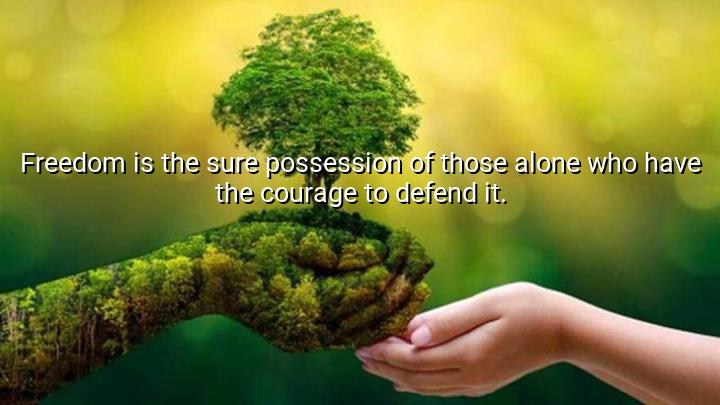




The quote "Freedom is the sure possession of those alone who have the courage to defend it" by Pericles emphasizes that freedom is not a passive right that can be taken for granted. Instead, it is something that requires active defense and courage to maintain. Pericles suggests that only those who are willing to stand up for their freedoms—through action, sacrifice, and resilience—truly possess it. Courage in the face of adversity is necessary to protect liberty, ensuring that it is not lost to external or internal forces.
Pericles, an influential statesman and orator in ancient Athens, was known for his leadership during the Golden Age of Athens. His era marked significant advances in democracy, arts, and philosophy. The quote reflects his belief in the value of individual responsibility in preserving the democratic freedoms of the city-state. Pericles understood that freedom, particularly in the context of a democratic society, could only be upheld by those willing to fight for it, whether through physical defense or active participation in civic duties.
The phrase "have the courage to defend it" underscores the idea that freedom is not merely an inherited privilege but something that requires sacrifice and commitment. Whether it is through military defense, political activism, or social action, defending freedom often involves standing against those who seek to undermine or restrict it. This requires personal bravery and the willingness to face challenges and potential loss in the pursuit of liberty.
Ultimately, Pericles’ quote teaches that freedom is not a guarantee but a responsibility. To truly possess it, individuals and societies must actively defend their rights and values. It serves as a call to action, urging people to protect the freedom they hold dear and ensuring that it is not taken for granted or easily lost. The quote highlights the inseparable link between courage and liberty, and the idea that the preservation of freedom is a collective effort.

DDaotiendat
This quote is empowering—it places the value of freedom squarely in the hands of those who are brave enough to protect it. But it also makes me reflect on the emotional toll that defending freedom can take. Do we adequately support those who carry this burden—whether they’re soldiers, activists, or whistleblowers? Courage is often celebrated, but do we really honor the sacrifices it demands?
TDNguyen Tien Dung
Pericles’s quote really got me thinking about historical revolutions and modern-day protests. It suggests that freedom is earned, not gifted. But what happens when the fight to defend it becomes violent or divisive? Is there a line where courage can be misused in the name of liberty? I wonder how societies can promote freedom while also ensuring it doesn’t come at the expense of peace or justice.
LHTran Lan Huong
I love how this quote connects freedom with courage—it reminds me that liberty isn’t guaranteed, and that it takes ongoing effort to preserve. But I’m curious: how do we define what counts as 'defense'? Is it just physical or political action, or does standing up for your own beliefs in daily life count too? It feels like this could apply to anything from voting to protest to personal integrity.
BNBach Ngo
This quote is stirring, but I also find it somewhat troubling. It implies that only those willing to fight deserve freedom. What about those who are too afraid, too wounded, or too oppressed to rise up? Do they not also deserve freedom? I get the sentiment about courage, but I think it risks excluding people who may not be able to defend their rights in traditional or visible ways.
NQNgo Huu Nhat Quang
Pericles’s statement resonates with the idea that freedom isn’t just a right—it’s a responsibility. But I can’t help wondering: does everyone have equal access to the tools and power required to defend it? What about marginalized groups who are systematically silenced or oppressed? Is courage enough when the systems in place are stacked against you? This quote raises important questions about justice and equity in the defense of liberty.