

For beautiful eyes, look for the good in others; for beautiful lips, speak only words of kindness; and for poise, walk with the knowledge that you are never alone.
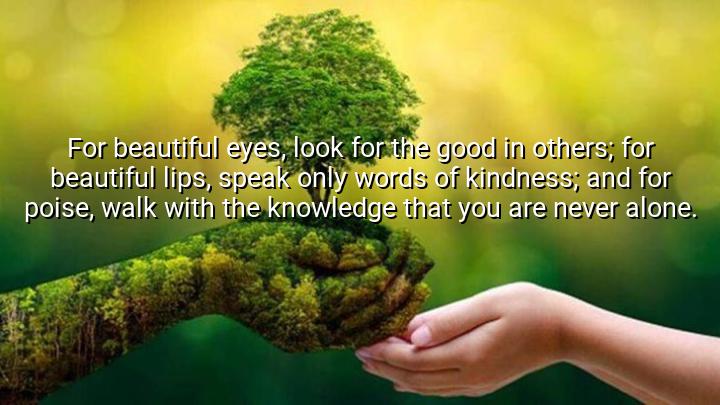




The quote "For beautiful eyes, look for the good in others; for beautiful lips, speak only words of kindness; and for poise, walk with the knowledge that you are never alone" by Audrey Hepburn conveys a message of inner beauty, kindness, and self-assurance. Hepburn suggests that true beauty is not merely external, but comes from positive thinking, compassionate words, and confidence. Instead of focusing on physical appearance, she encourages cultivating inner qualities that radiate outward, creating a more genuine and lasting form of beauty.
Audrey Hepburn, a renowned actress, fashion icon, and humanitarian, is celebrated for her elegance both on-screen and in her personal life. She often spoke about the importance of inner values over superficial traits. This quote reflects her belief in humanity and the power of kindness, suggesting that a beautiful person is one who embodies grace and goodness, both in thought and action.
The advice to "look for the good in others" and "speak only words of kindness" emphasizes the importance of fostering a positive and compassionate mindset. Hepburn believed that by focusing on the good in people and speaking kindly, we not only enhance our own well-being but also contribute to a kinder and more loving world. This aligns with her larger belief in the power of empathy and love.
Finally, the phrase "walk with the knowledge that you are never alone" speaks to self-assurance and the importance of inner strength. Hepburn suggests that poise comes from the understanding that, regardless of external circumstances, we are supported by our inner resources, faith, or the presence of others who care for us. This message encourages confidence that stems from a deep sense of connection and self-worth, rather than from external validation.

HNHieu Nguyen
I really want to live by these words, but how do you keep this mindset when dealing with toxic people? It’s one thing to speak kindly and see the good in others when you’re surrounded by love, but what about when you’re faced with cruelty or manipulation? Is it still healthy to apply this principle, or is there a point where boundaries matter more than kindness?
QMTram Quoc Minh
Is this quote perhaps a subtle critique of how society has traditionally defined physical beauty? Instead of focusing on appearance, it seems to suggest that real attractiveness stems from how we treat others and how we carry ourselves. I wonder how this idea would hold up against the pressures of social media and influencer culture, where looks often seem to be the currency of worth.
HPHang Phamthu
This quote makes me think: is the idea of ‘never being alone’ rooted in spirituality, or is it more about a sense of community and connectedness with others? I’d love to know what Hepburn herself meant by that phrase. It resonates, but I’m not sure how to interpret it—especially in a world where loneliness is on the rise. Can we feel truly connected just by believing we aren’t alone?
MMMi Mi
I love how this quote reframes beauty as something more internal and intentional. That said, I’d like to hear different cultural takes on this message. Are there traditions or philosophies in other parts of the world that echo these values of kindness, empathy, and spiritual grace as forms of beauty? It would be fascinating to see how universal or localized this perspective really is.
XHXuan Huy
Audrey Hepburn's words are poetic and timeless, but do they risk oversimplifying the concept of beauty and poise? While I admire the sentiment, I wonder if people struggling with self-image or trauma might find this advice a bit abstract or even inaccessible. How can we bridge this kind of internal elegance with the complex emotional realities people face every day?