

Every man must do two things alone; he must do his own believing and his own dying.
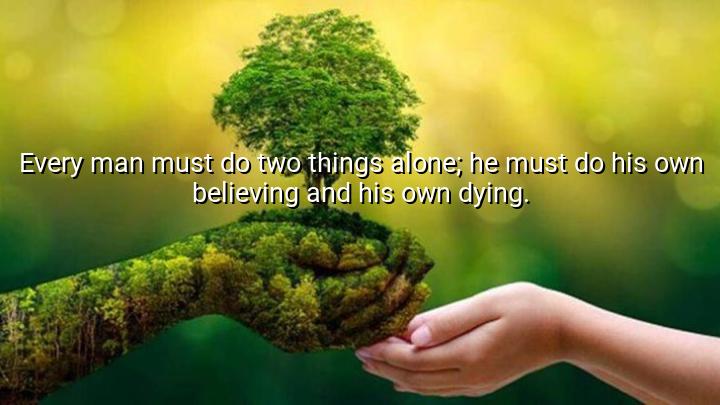




The quote "Every man must do two things alone; he must do his own believing and his own dying" by Martin Luther speaks to the deeply personal and individual nature of both faith and mortality. Luther emphasizes that no one else can take our place when it comes to what we believe or how we face our own death. These two experiences are at the core of human existence, and they must be faced alone, guided by one's conscience and inner truth.
Martin Luther, a 16th-century theologian and leader of the Protestant Reformation, was known for challenging the authority of the Church and advocating for direct, personal relationship with God. This quote reflects his belief in individual responsibility and the importance of personal conviction. According to Luther, true faith cannot be inherited or imposed—it must be chosen and embraced from within.
Similarly, the experience of dying is something that no one can share on our behalf. While others can offer support or comfort, each person must ultimately confront their own mortality, reflect on their life, and find peace in their own way. Luther’s words are a reminder that both belief and death are journeys that, though universal, must be traveled individually.
Ultimately, the quote is both sobering and empowering. It encourages us to take ownership of our spiritual life and to live with the awareness that certain moments—our deepest beliefs and our final breath—are ours alone. In recognizing this, we are invited to live with greater integrity, authenticity, and courage.

YTyen truong
Luther’s quote is undeniably profound, but I feel a little overwhelmed by it. Is it possible to prepare ourselves for this solitude? Can we practice being alone with our beliefs, or imagining our mortality, in ways that make those moments less frightening? I believe community is important, but maybe part of maturing is learning to stand alone with the most difficult truths. It’s sobering, but also maybe empowering.
HNHa Nguyen
This is one of those quotes that stays with you. It makes me reflect on how much we seek companionship, yet when it comes to belief and mortality, we face them in solitude. Is that why these two things feel so heavy? I wonder if knowing this early in life would change how we live—maybe we’d be more intentional with our values and more fearless about accepting death when it comes.
DADuc Anh
There’s a quiet bravery in this quote. It acknowledges the inevitable solitude in the most defining parts of human life. But I’m torn—should we accept this solitude, or try to lessen its weight by leaning on others while we can? I guess I’m asking: does facing belief and death alone mean we shouldn’t seek guidance or comfort? Or does it just mean no one else can make the final choice for us?
YHyennn haiii
I keep thinking about how belief is often shaped in community—religion, culture, mentors. Yet Luther suggests that in the end, we have to choose our beliefs alone. That’s a huge responsibility. It makes me question: how many of my beliefs are truly mine, and not just inherited? This quote challenges me to think about authenticity and whether I’ve really done the inner work of owning my convictions.
DMnguyen duy manh
This quote really hits me in the gut. It’s powerful—and kind of haunting. Belief and death are such intimate, deeply personal experiences. No matter how surrounded we are by others, there’s a core part of both that no one else can step into with us. But it makes me wonder: is it comforting or isolating to know that these two ultimate acts are solitary? Can solitude also be sacred in those moments?