

Every man is born as many men and dies as a single one.
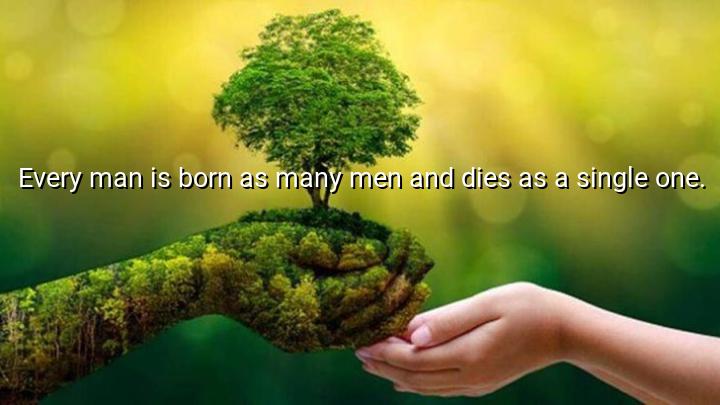




The quote "Every man is born as many men and dies as a single one" by Martin Heidegger reflects his deep exploration of identity, individuality, and human existence. Heidegger suggests that when a person is born, they are full of potential—open to many paths, roles, and possibilities. At the start of life, one exists as a blend of many selves, shaped by culture, family, and future choices. This multiplicity represents the wide range of what a person could become.
However, by the time a person dies, they have lived a specific life and made concrete choices that shaped them into a single, defined individual. This means that the act of living is also the process of narrowing—selecting from the many possible versions of ourselves until we arrive at the person we have become. In this way, death reveals the final unity of self: not what was possible, but what was actualized.
Martin Heidegger, a 20th-century German philosopher, is best known for his influential work Being and Time, where he examined the nature of being, authenticity, and mortality. This quote is rooted in his idea that to live authentically, one must confront the reality of death and take responsibility for their life’s direction. It speaks to the existential journey of becoming a true individual through lived experience.
Ultimately, Heidegger’s quote invites reflection on how we shape our identity through choices, and how those choices define us in the end. It emphasizes that while life begins with endless possibilities, it gains meaning through the process of becoming a singular self—a person who has chosen a path, embraced responsibility, and faced life with authenticity.

DDDiep Dau
Heidegger’s words feel both existential and deeply human. I interpret them as a comment on individuation—the psychological and spiritual process of becoming a singular, unified self. But I also worry: does this mean we lose something essential in the process? The child who imagined being a hundred things—do they fade away, or do they quietly inform who we become? This quote makes me question whether narrowing identity is growth or quiet loss.
PJPack jimin
This quote struck me like a quiet revelation. If we begin as many and end as one, does that mean selfhood is less about expansion and more about distillation? I think of how, as we age, we shed dreams, personas, and even illusions. Is the 'single one' our truest self—or just the version that survived? That raises a powerful question: do we grow into authenticity or settle into resignation?
TPLe tran phuc
There’s something hauntingly beautiful about this quote. It suggests that life is a journey from complexity to clarity—or maybe chaos to self. But I wonder, what role do others play in helping us become that 'single one'? Are we carving our identity alone, or is it shaped and reflected by our relationships, culture, and environment? The idea that we die as just one person makes me ask: which one wins out, and why?
BTNguyen Bao Tran
This really makes me reflect on identity. At birth, we’re full of endless possibilities—roles we might play, people we might become. Over time, choices, values, and even regrets seem to shape us into someone more specific. But is that inevitable? What if someone resists that crystallization? Does that make their life more fragmented or more authentic? I’d love to know if Heidegger saw this process as fate, freedom, or simply existential design.
ANAnh Ngoc
I find this quote thought-provoking. It seems to imply that life is a process of refinement or reduction, from many possibilities to one truth. But is that a good thing? Does settling into a single identity represent maturity—or limitation? I wonder if some people resist this narrowing, choosing instead to remain many 'selves' throughout life. Is that even sustainable, or does our nature demand that we eventually settle into a unified version of ourselves?