

Even in the presence of others he was completely alone.
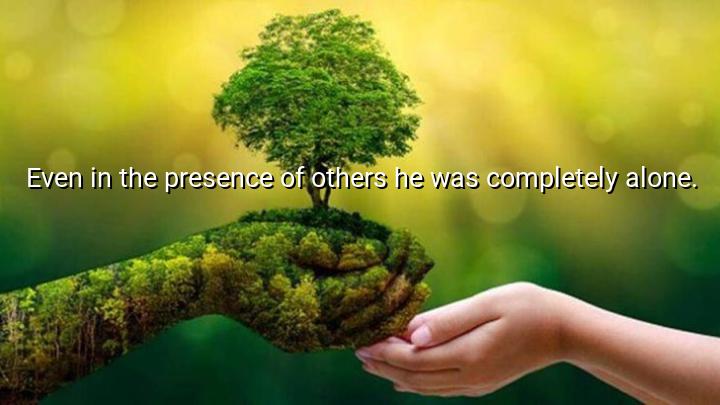




The quote "Even in the presence of others he was completely alone" by Robert M. Pirsig reflects a powerful and often painful truth about loneliness—that it is not simply the absence of people, but the absence of connection. Pirsig highlights the emotional state in which someone can be surrounded by others, yet still feel isolated, unseen, or disconnected. This kind of inner solitude suggests a deeper level of detachment, where meaningful interaction is missing even in social settings.
Robert M. Pirsig is best known for his philosophical novel Zen and the Art of Motorcycle Maintenance, where he explores themes of identity, consciousness, and the search for meaning. This quote aligns with the introspective and existential tone of his work, in which characters grapple with alienation and the challenge of finding truth and authenticity in modern life. The idea of being alone in a crowd speaks to the emotional complexity of someone who feels fundamentally out of sync with the world around them.
The phrase "completely alone" intensifies the sense of emotional emptiness, indicating that mere physical presence of others cannot cure the deeper feeling of isolation. It points to a condition where internal disconnection—from self, purpose, or others—overshadows any outward social interaction. This kind of solitude often leads to deep introspection, and in Pirsig’s case, becomes a central theme in his philosophical exploration of life and consciousness.
Ultimately, Pirsig’s quote invites us to reflect on the nature of true connection. It challenges the assumption that being with people is the same as being connected to them, and reminds us that emotional presence, understanding, and authenticity are what truly break the bonds of loneliness. Without those, even a room full of people can feel silent and empty.

CNCong Nguyen
There’s something haunting and poetic in this quote. It raises the question — can someone be truly alone if they're emotionally disconnected, even in the most social environments? Does it mean that real companionship requires vulnerability and mutual recognition? I wonder how many people carry this feeling silently and whether we’re doing enough to create spaces where emotional authenticity is welcomed.
KNKevin Noob
This quote makes me think of how introverts or highly sensitive people might experience the world. It’s possible to be surrounded and still feel like no one understands your inner world. Is it because we’re taught to perform social roles instead of showing our real selves? Maybe loneliness, in this sense, comes not from lack of people but from too much pretense in how we relate to one another.
KNNguyen Thi Kim Nhu
Isn’t it strange how we can live in such a connected world and still feel like this quote describes us? It makes me question whether the relationships we build are meaningful enough or just convenient. Are we prioritizing quantity over quality in our social lives? Maybe that’s why people can feel more alone in a crowd than when they’re by themselves. What does genuine connection look like today?
NATruong Ngoc Anh
This hits on something I think a lot of people experience but don’t talk about. Being surrounded by others doesn’t guarantee connection. Could this be a symptom of not feeling safe enough to be authentic around others? I wonder how much of this kind of loneliness is self-imposed — a protective mechanism — and how much is due to a real lack of emotional resonance with those around us.
THTran Tien Hung
I find this quote deeply melancholic. It seems to capture the quiet ache of disconnection, even in shared spaces. What’s worse — being physically alone or emotionally invisible? I think that kind of loneliness is harder to spot and even harder to admit. Do we, as a society, know how to respond to this kind of emotional disconnection, or are we still focused too much on surface-level togetherness?