

Death is the mother of Beauty; hence from her, alone, shall come fulfillment to our dreams and our desires.
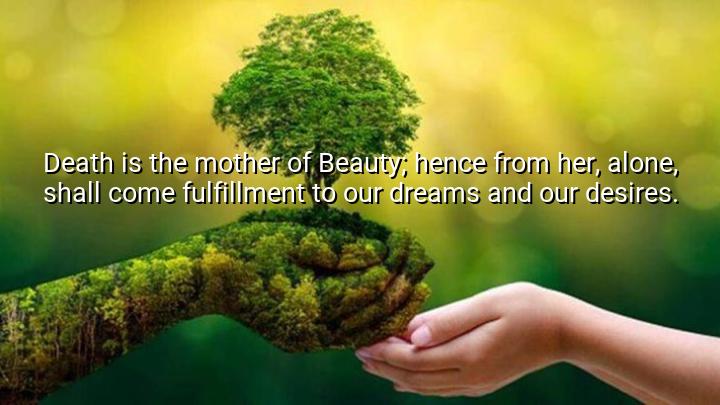




In this quote, Wallace Stevens presents a profound and philosophical view on death and its relationship to beauty and fulfillment. He suggests that death is the mother of beauty, meaning that the awareness of mortality and the finite nature of life give beauty its value and meaning. Stevens implies that without death, beauty would not hold the same significance or urgency, as the transient nature of life makes our experiences and desires more precious. Death serves as a backdrop against which beauty and fulfillment become meaningful.
Stevens further argues that it is only through death that we can achieve fulfillment in our dreams and desires. The concept of death's inevitability pushes us to recognize the fleeting nature of our lives, compelling us to seek meaning, beauty, and satisfaction before time runs out. The awareness of mortality fuels our desire to make the most of our existence, driving us to pursue our goals and aspirations with a sense of urgency and purpose. In this sense, death acts as both a reminder and a catalyst for living fully.
The idea of death giving rise to beauty also reflects Stevens' broader existential and poetic views. He often explored themes of impermanence, change, and the interplay between life and death in his works. By stating that death is the mother of beauty, Stevens touches on the paradox that the end of life makes the moments of living and the beauty we encounter even more profound and impactful. Beauty is something to be cherished precisely because it is fleeting, and death highlights its transience.
Ultimately, Stevens' quote serves as a reflection on the transience of life and how our awareness of death shapes our perception of beauty and fulfillment. It encourages us to embrace the impermanence of life and to find meaning in the moments we have, knowing that it is the inevitability of death that makes our dreams, desires, and the beauty we encounter truly significant.

HGPhan Nguyen Huong Giang
There’s a quiet intensity in this idea that death is not the opposite of fulfillment, but its origin. That challenges so many of our instincts to fear or avoid death at all costs. But I have to ask—can this perspective truly comfort someone who is grieving? Or is it more of a philosophical lens than an emotional truth? I’m curious how others have reconciled this idea in their own experiences.
HVHuy Vo
This quote brings to mind how grief often deepens our appreciation of beauty. After loss, colors seem more vivid, music more stirring. It’s strange how death can awaken a kind of heightened sensitivity to life. But I wonder—does beauty always need contrast to exist? Or can we learn to see it fully in moments of peace and presence, without needing the shadow of death to define it?
HVPham Ha Vy
Stevens’ words seem to suggest that the awareness of death gives shape to our desires and dreams. I find that idea compelling—like our mortality is what gives urgency and purpose to our hopes. But does that mean fulfillment is only possible because of limitation? What would ambition or longing look like in a world without death or endings? Would we still be driven to create or connect?
HCPham nguyen ha chau
There’s something incredibly profound in this quote. It makes me think about how much of what we find beautiful—sunsets, farewells, seasons—are tied to endings. But it also makes me ask: is this a romanticization of death? Can we find beauty without pain or loss? I’m torn between admiring the depth of the thought and questioning whether it’s too dark to embrace fully.
PTNguyen Phuong Thuy
This quote is haunting and poetic, but I can’t help wondering—why must death be the source of beauty? Is it the idea that impermanence makes things more meaningful? I find that concept both deeply moving and unsettling. It raises the question: would we value love, art, or nature less if they lasted forever? Maybe the fleeting nature of life forces us to cherish what we might otherwise overlook.