

Cinema connects people: they respond as a group, you feel you are not alone, and you see you are not alone. Capitalism is destroying this social aspect of films, and even empathy, by creating the illusion that you are more important than the next person: 'You will buy this because you are special.' That is horrible.
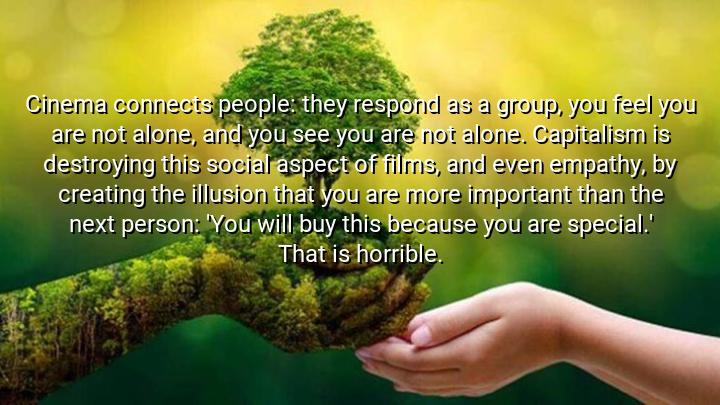




In this quote, Jasmila Žbanić, a Bosnian filmmaker, explores the power of cinema to create a shared experience among people. She suggests that movies have the ability to connect people, as they respond to films collectively and realize that they are not alone in their emotions or experiences. This shared experience fosters a sense of community and empathy, allowing people to bond over the universal themes and emotions depicted on screen. However, Žbanić critiques how capitalism is undermining this social aspect of films by turning the viewing experience into something more individualistic and consumer-driven.
Žbanić points out that capitalism is eroding the collective experience of cinema by promoting the idea that people are special and unique in a way that encourages consumerism. The line "You will buy this because you are special" reflects how marketing strategies attempt to create the illusion that the individual is more important than the collective. This, according to Žbanić, leads to a breakdown in empathy and the sense of belonging that cinema once provided. Instead of uniting viewers, the capitalist model promotes isolation and individualism.
The origin of this quote can be traced to Žbanić’s work as a filmmaker, where she often tackles themes of social cohesion and human connection. Having experienced the power of storytelling through cinema, she sees firsthand how film can bring people together, offering a rare space for shared emotion and understanding. However, Žbanić is critical of the commercialization of film, which often prioritizes profit over the deeper human connections that cinema can foster.
In essence, Žbanić’s quote is a reflection on how capitalism disrupts the social and emotional potential of cinema. She laments the shift from films as a unifying cultural experience to films as a product marketed to individuals. This change not only diminishes the sense of community but also weakens the empathy that films once nurtured among audiences, ultimately creating a more fragmented society.

TTNguyen Thuy Trang
Reading this, I wonder about the responsibility of filmmakers and studios in combating this trend. Can storytelling itself challenge the capitalist narrative by emphasizing collective experiences and empathy? How might independent cinema contribute to preserving the communal spirit of film? It seems important to balance commercial success with cultural and social impact.
HVHang Vu
This quote suggests capitalism creates a harmful illusion of individual importance that undermines social cohesion. How might this mindset extend beyond cinema into other aspects of life? Can media literacy or education help audiences recognize and resist such isolating narratives? It would be interesting to explore how awareness can rebuild empathy through shared cultural experiences.
A8Hong Anh 8/3
Zbanic’s comment makes me reflect on how movie theaters once served as gathering spaces fostering empathy. How has the rise of personalized media consumption changed this? Are there ways to revive shared viewing experiences in an era dominated by individual screens and targeted marketing? What role do festivals or community screenings play in preserving cinema’s social aspect?
UGUser Google
I find the connection between capitalism and empathy fascinating here. Does commodifying art inherently risk reducing human connection? Or can capitalism coexist with genuine communal experiences if managed differently? This prompts me to think about alternative economic models in the arts that prioritize social engagement over individual profit.
PKPhan Khoa
This quote raises an important critique of consumer culture in entertainment. Could the idea of ‘you are special’ in advertising diminish collective experiences and shared emotions? How do you think this affects not just cinema but other art forms as well? I’m curious about ways filmmakers and distributors could reclaim the social, empathetic power of movies.