

Being alone is very difficult.
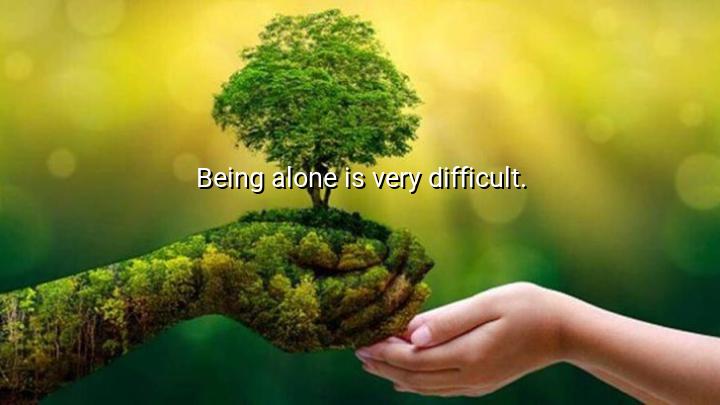




The quote "Being alone is very difficult" by Yoko Ono speaks to the emotional and psychological challenges that come with solitude. Ono acknowledges that aloneness, while sometimes necessary or even healing, can also be painful and unsettling. This statement strips away any romanticism around being alone and points directly to the human struggle with isolation and the need for connection.
Yoko Ono, an avant-garde artist, musician, and peace activist, often explores themes of loss, identity, and emotional vulnerability in her work. Known for her deep reflections on life, particularly following the death of her husband John Lennon, Ono has frequently addressed the experience of grief and loneliness. This quote reflects her honest perspective that despite strength and independence, the act of being truly alone is one of life’s most difficult emotional states.
The word "difficult" in this context conveys more than just discomfort—it hints at a deeper emotional labor, where one must confront their own thoughts, fears, and the absence of shared human experience. Many people find themselves unsettled when they are alone because it exposes vulnerabilities and removes distractions. Ono’s quote validates those feelings, offering a moment of shared truth for anyone who has grappled with being by themselves.
Ultimately, Ono's quote serves as a compassionate reminder that solitude is not always peaceful—it can be a real challenge, emotionally and spiritually. Her words resonate with anyone who has felt the weight of silence or the ache of disconnection, and they highlight the courage it takes to sit with oneself and endure what being alone truly entails.

HHHai Ha
I’m curious — if being alone is so difficult, why is it often seen as a necessary part of healing or growth? Maybe the difficulty is what makes it transformative. But it also raises the question: should we really have to suffer through solitude to understand ourselves better? Can community and introspection coexist, or are they fundamentally different paths to self-awareness?
MA02 - Huynh Ngoc Minh Anh
This resonates deeply, especially for people going through transitions — breakups, grief, career changes. Being alone isn’t just about not having people around, it’s about confronting everything without a buffer. Is that why some people avoid solitude at all costs, even if it means staying in toxic situations? How do we build emotional muscles for solitude without falling into isolation?
THLan Anh_9C_2007 Trieu Hoang
This quote really makes me reflect on modern life. We’re constantly surrounded by stimulation, noise, and people — whether physically or digitally — so the rare moments of actual aloneness can feel jarring. Have we made ourselves too dependent on distraction? I wonder how many of us fear being alone not because we’re lonely, but because we’re unpracticed in sitting with silence and self.
TDThikieu Duong
This line makes me want to ask: what kind of ‘alone’ are we talking about? Physical solitude? Emotional isolation? Existential disconnection? Each has its own kind of difficulty. I think it’s powerful that Yoko Ono, someone so publicly known, acknowledges how tough it is. Do public lives make private solitude even harder, or does fame mask a more profound loneliness most of us can’t see?
NVHao Nguyen Van
I find this quote incredibly honest. Society often treats being alone as a weakness or failure, yet so many people struggle to be with themselves. Is it just the absence of company that’s hard, or the presence of our own thoughts without distraction? It makes me wonder if learning to be alone is actually a skill — something we have to cultivate over time, not something that comes naturally.