

Art makes us feel less alone. It makes us think: somebody else has thought this, somebody else has had these feelings.
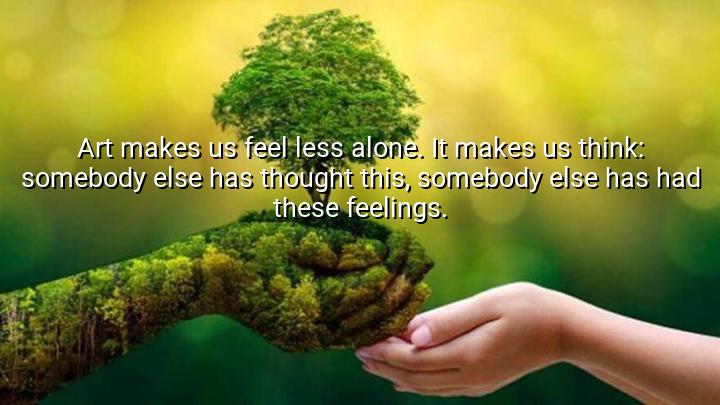




The quote "Art makes us feel less alone. It makes us think: somebody else has thought this, somebody else has had these feelings" is from Alan Moore, an English writer best known for his work in graphic novels, such as Watchmen and V for Vendetta. In this statement, Moore reflects on the power of art to connect individuals and provide a sense of solidarity. He suggests that art has the unique ability to make us feel understood by revealing that others share our thoughts and emotions, helping to alleviate the feeling of isolation that often accompanies personal struggles.
Moore emphasizes that art serves as a form of communication between creators and audiences. Whether through visual art, literature, or music, the artist conveys universal themes that resonate with others. This shared human experience makes people realize they are not the only ones who have faced certain challenges or felt certain emotions. By experiencing art, we understand that our individual experiences are not isolated but part of a larger human story.
The phrase "somebody else has had these feelings" speaks to the comforting realization that others have gone through similar emotional journeys. Art provides a platform for expressing complex feelings and ideas, which might otherwise be difficult to articulate. It creates a connection between the artist and the audience, helping individuals feel part of a larger community of people who understand and empathize with their experiences.
In essence, Moore’s quote underscores the unifying and healing power of art. It serves as a reminder that through art, we can find solace in knowing that others share our experiences. This sense of belonging and validation is crucial in helping individuals overcome feelings of loneliness and find comfort in the shared nature of the human condition.

ANNguyen Thi Anh Ngoc
This makes me think—can art be a kind of therapy for both the creator and the audience? It’s comforting to know others have shared your struggles, but does that also mean artists have to constantly mine their pain to help others feel less alone? I sometimes worry that we expect too much emotional labor from artists. How do they protect their well-being while staying honest in their work?
NMNguyen Minh
I find this quote both beautiful and validating. It reminds me why representation matters—seeing your experience reflected in art tells you you're not invisible. But what happens when your voice isn’t represented at all? Does that deepen the sense of isolation? I think Moore’s words carry an important message about inclusivity in art, and how powerful it is when someone finally sees themselves in a poem, a film, or a comic.
PLPhuong Le
Alan Moore really nails something here. That sense of being seen through someone else's creation is so comforting. But it makes me curious—does this connection require the art to be personal, or can something abstract or even fictional still make us feel less alone? I’ve cried over sci-fi and laughed at surrealist pieces—so maybe relatability is more about emotion than realism?
BDBao Duy
This line makes me emotional. It perfectly explains why I’ve always turned to stories or paintings when I feel overwhelmed. But I wonder—can digital media and algorithms replicate this kind of connection, or does the commodification of art dilute its ability to comfort us? Is there a difference between mass-produced content and genuine artistic expression when it comes to making us feel understood?
YNY Nhu
I really relate to this quote. There have been moments when I’ve read a book or heard a song and felt like the artist reached into my own thoughts. Do you think that’s the ultimate power of art—creating that emotional bridge between people who may never meet? I wonder if that’s why art has always existed in every culture, as a kind of invisible thread holding us all together.