

Alone let him constantly meditate in solitude on that which is salutary for his soul, for he who meditates in solitude attains supreme bliss.
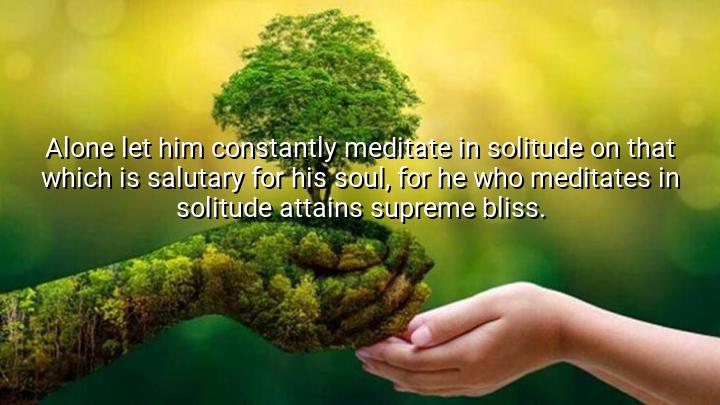




The quote "Alone let him constantly meditate in solitude on that which is salutary for his soul, for he who meditates in solitude attains supreme bliss" by Guru Nanak emphasizes the spiritual importance of solitude and meditation. Guru Nanak teaches that by withdrawing from the distractions of the world and turning inward, a person can focus on what is truly nourishing for the soul. This inner focus allows the seeker to connect with divine truth and ultimately experience supreme bliss—a state of spiritual fulfillment and peace.
Guru Nanak (1469–1539), the founder of Sikhism, was a profound spiritual teacher who traveled widely to share messages of divine unity, compassion, and self-realization. In his writings and hymns—many of which are preserved in the Guru Granth Sahib, the Sikh holy scripture—he often stressed the value of meditative solitude as a means to grow closer to God and understand one’s true nature. This quote reflects his belief that deep, personal contemplation is essential for spiritual development.
The phrase "meditate in solitude" conveys not just physical isolation, but a mental and spiritual discipline. In the quiet of solitude, the distractions of the ego and the outside world fade, creating space for clarity, devotion, and inner transformation. By focusing on what is "salutary"—that is, healthy, virtuous, and uplifting—the individual moves toward liberation and bliss.
Ultimately, Guru Nanak’s quote offers a timeless lesson: solitude, when used intentionally for spiritual reflection, becomes a sacred path to awakening. In a world full of noise and attachment, true peace comes not from external achievements, but from the quiet, sustained connection to the soul through meditation and inner awareness.

GHNguyen Gia Huy
There’s something profoundly reassuring about this quote—it presents solitude not as emptiness, but as sacred space. I’m drawn to the idea that stillness can lead to enlightenment. But I’m curious: how do we define what is 'salutary for the soul'? Is that a personal discernment, or does it come through tradition and guidance? This makes me want to explore how different faiths interpret and apply this idea of solitary meditation.
ATBui Anh Thu
I find this quote deeply spiritual, yet it brings up a concern: for those who struggle with loneliness or silence, is solitude really blissful—or is it overwhelming? Does meditation in solitude require a certain level of emotional or mental readiness? I think the idea is beautiful, but it also assumes that being alone is inherently peaceful, when for many, it can be anything but. How do we bridge that gap?
HGHuong Giang
This quote offers a serene and purposeful view of solitude, which I find inspiring. But it also raises a question: does the journey to 'supreme bliss' through meditation require detachment from others? How do we reconcile the spiritual benefits of being alone with the human need for community and love? It feels like a tension between inner awakening and shared experience. Can both coexist, or does one ultimately take priority?
TTThanh Tran
I admire the clarity and conviction in this quote, but I also find it intimidating. Constant meditation in solitude sounds ideal, but is it attainable for the average person balancing work, relationships, and responsibilities? Can short, sincere moments of reflection still bring the same kind of spiritual benefit? I’d love to know how modern seekers interpret Guru Nanak’s emphasis on solitary practice in today’s interconnected world.
ATAnh Thu
This quote feels both peaceful and demanding. It makes me reflect on how rare true solitude and focused meditation are in modern life. Can someone living in a noisy, fast-paced world still access that kind of spiritual depth? I wonder if this teaching is literal or metaphorical—must one physically be alone, or can one achieve inner solitude even amidst daily chaos? It challenges me to rethink how I approach spiritual practice.