

All we ask is to be let alone.
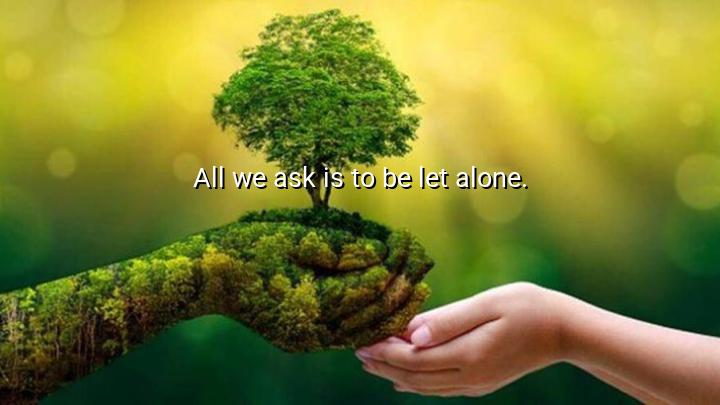




The quote, "All we ask is to be let alone," is from Jefferson Davis, the president of the Confederate States during the American Civil War. This statement reflects Davis' desire for the South to be left to govern itself without interference from the federal government of the United States. It speaks to the broader issue of states' rights and the growing tensions between the North and South over political, economic, and social differences.
Davis' words are rooted in the South's belief that the federal government was overstepping its authority, particularly in relation to slavery and the rights of individual states. The South's demand to be left alone was a call for independence and self-determination, which ultimately led to the secession of Southern states and the formation of the Confederacy. This plea reflects the Southern mindset that their way of life, including slavery, should not be dictated by the policies of the North.
The phrase "to be let alone" also conveys a desire for freedom from external control and a wish for peaceful coexistence, albeit under different systems. It suggests that the South did not want conflict but felt it had no other option but to separate from the Union to preserve its values and economic system.
Ultimately, Davis' quote encapsulates the core sentiment of the Southern cause during the Civil War. It is a reflection of the South's deep desire for autonomy and its belief in the right to self-govern without interference. This desire for independence was one of the key factors that led to the conflict between the North and the South, as both regions had fundamentally different visions of what America should be.

THNguyen Thi Thu Ha
This brief but powerful quote brings to mind questions about sovereignty—personal, cultural, and national. How does this idea of wanting to be left alone relate to contemporary issues like privacy rights, indigenous land claims, or secession movements? I’m interested in exploring how the concept of being 'let alone' is both a political and deeply human plea.
KTNguyen Kieu Trang
I wonder about the emotional undertones behind this phrase. Is it born from frustration, fear, or a longing for peace? How might such a statement be received differently by those who feel oppressed versus those in positions of power? This raises questions about who gets to demand to be left alone and who is expected to accommodate those demands.
TNThien Nguyen
This quote makes me reflect on the historical weight behind Davis’s words and how 'being let alone' can carry different meanings depending on context. Was it a statement of defense, defiance, or desperation? And today, how do groups claim the right to autonomy without infringing on others’ rights? It’s a complex issue in multicultural and political landscapes.
TMMinh ko thong minh
Reading this, I’m struck by the simplicity and directness of the request, yet I question its feasibility. Is it realistic to expect complete solitude or non-interference in interconnected societies? How do nations, groups, or individuals negotiate boundaries when total isolation isn’t possible? It also makes me think about marginalized communities seeking recognition versus wanting to be 'left alone.'
HMLe Hien My
I find this statement evocative of a universal human wish for peace and freedom from interference. But I’m curious—does the desire to be left alone conflict with the responsibilities we have toward society and others? How do we balance individual liberty with communal obligations? This tension seems central to political philosophy and social contracts.