

All love is lost but upon God alone.
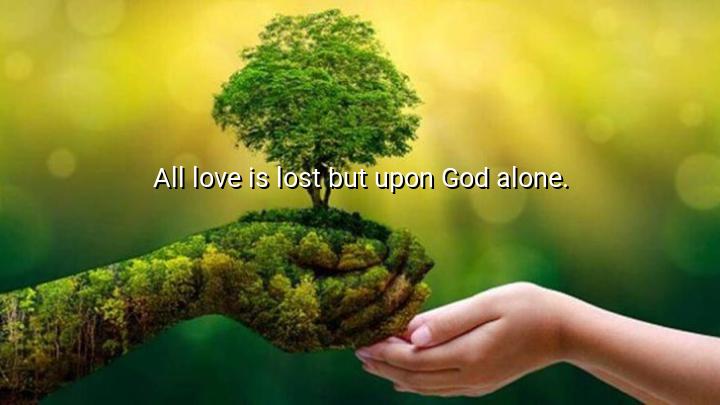




The quote "All love is lost but upon God alone" by William Dunbar reflects a deep spiritual perspective on love and human connection. Dunbar, a Scottish poet of the Middle Ages, expresses the idea that human love—whether romantic, familial, or platonic—is ultimately fleeting and imperfect. The phrase suggests that the only true and everlasting love is divine love, specifically the love found in a relationship with God. In a world full of transitory relationships, Dunbar emphasizes that only God’s love remains constant and unchanging.
Dunbar’s assertion also alludes to the transitory nature of human affection and the inevitable disappointments that arise from relying on human connections. While human love can provide joy and comfort, it can also be marked by loss, betrayal, and failure. This is why Dunbar places God’s love above all other forms, portraying it as the sole source of unconditional and eternal love that never falters or fails.
The quote can also be seen as a reflection of the medieval Christian worldview, where faith in God’s love was often regarded as the ultimate source of strength, purpose, and fulfillment. Dunbar likely believed that by placing all trust and devotion in God, one could find true peace and contentment, as opposed to the fleeting and often fragile love shared between people.
Ultimately, Dunbar’s words encourage individuals to seek and embrace divine love as a source of stability and fulfillment in a world where human love can be uncertain. His focus on God alone highlights the importance of spiritual devotion as the foundation of enduring love and emotional well-being.

TVThao Vuong
This quote brings up a philosophical question for me: is love only truly meaningful if it’s eternal? If so, then I can understand why Dunbar would say only divine love endures. But does that mean temporal love—love that ends, changes, or fades—is worthless? I don’t think so. Can’t impermanent love still shape us, heal us, or reveal something transcendent, even if it doesn’t last forever?
TSTran Thi Soan
It’s a profound statement, but I’m not sure I agree. Yes, human love can be flawed and fleeting, but doesn’t that impermanence make it more precious, not less? To say all love is lost except for love of God might comfort those with deep faith, but it risks discounting the richness of human connection. Is this quote more poetic than literal, or is it rooted in a strict spiritual worldview?
GDGold D.dragon
This quote has a kind of tragic beauty to it. It sounds like the voice of someone who’s been disappointed by the world and turned inward toward faith as the only source of lasting meaning. But it also raises the question: is faith something we turn to when all other loves fail, or is it the foundation from which all other loves gain value? I’d love to hear how people interpret this balance.
VNVy Nguyen
I find this line hauntingly absolute. Is Dunbar suggesting that love given to anyone or anything other than God is inherently wasted? That raises a question for me—what about love between parent and child, or between spouses who support each other through life’s challenges? Are those bonds considered lesser or transient in comparison to spiritual devotion? It feels like a deeply religious yet emotionally complex idea.
HHDao Huy Hung
This quote makes me wonder—does Dunbar mean that all earthly love is doomed to fail or fade, while only divine love remains constant? It’s a powerful sentiment, but also a bit bleak if you believe in the beauty of human relationships. Can’t love between people, when sincere and selfless, reflect or even honor divine love? I’m curious whether this is a theological stance or a reflection of personal heartbreak.