

A man is rich in proportion to the number of things he can afford to let alone.
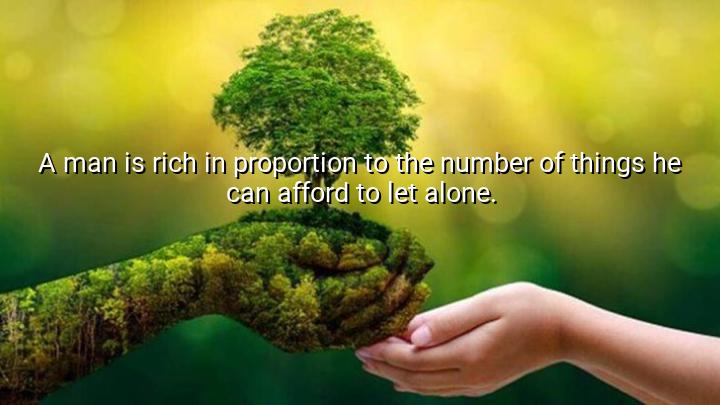




The quote "A man is rich in proportion to the number of things he can afford to let alone" by Henry David Thoreau highlights the idea that true wealth comes not from possessions or material success, but from the ability to live simply and prioritize what truly matters. Thoreau, a philosopher and author best known for his work Walden, was a strong advocate for minimalism and the value of living with fewer material distractions. In this quote, he suggests that a person is truly wealthy when they can detach from unnecessary things and focus on what brings them peace and fulfillment.
Thoreau’s perspective challenges the conventional definition of wealth, which is often tied to material accumulation. Instead, he proposes that the ability to let go of desires and live with less is a sign of true richness. This approach emphasizes the freedom and contentment that come from reducing one’s attachment to the material world and finding happiness in the simple and essential aspects of life.
The idea behind this quote also speaks to the concept of self-discipline and the freedom that comes from controlling one’s desires. The more someone can resist the urge to accumulate things—whether possessions, achievements, or distractions—the more they can focus on what is genuinely valuable in life, such as inner peace, relationships, and personal growth. Thoreau’s words suggest that true freedom comes not from owning more but from being able to live without the constant need for more.
Ultimately, Thoreau’s quote encourages us to rethink our values and consider what it means to be truly rich. Instead of measuring wealth by material goods or status, Thoreau offers a more profound definition of richness—one based on simplicity, freedom, and the ability to live without the constant pressure of accumulating more.

Kkcheese
This quote makes me think about power—not in a controlling way, but the quiet kind that comes from knowing you don’t need something to feel whole. What would it look like to live a life where you could pass on temptations or opportunities and still feel content? Is that the ultimate richness—to need less, not more? It’s a radical idea, especially in a culture built on craving and consumption.
NNNguyenvanphuong Nguyenvanphuong
I find this quote both inspiring and a little unsettling. If wealth is measured by what we can leave alone, doesn’t that require a huge amount of inner strength and clarity? It makes me ask—how do we build that kind of discernment? Is it a product of age, wisdom, or experience? Or is it something that has to be practiced, like a kind of spiritual discipline?
TTChim teo Tuan
This feels like a statement on minimalism before it was trendy. But I also hear a subtle challenge—how much of what we cling to is out of fear? Do we chase possessions, people, or goals because we're truly passionate, or because we’re afraid of being left with ourselves? Thoreau might be calling us to examine whether our attachments serve us, or if we’re just serving them.
KNHuynh Ngoc Khanh nhi
Thoreau’s quote makes me think about emotional wealth, not just material detachment. Could it mean that peace comes from not needing to control, fix, or respond to everything around us? If so, that’s incredibly relevant in the age of social media and endless stimulation. How often do we mistake constant engagement for fulfillment, when in reality, letting go might be what frees us most?
KPPham kiem phong
I love the simplicity of this idea. But is it realistic in today's society? We’re constantly bombarded with options, pressure, and obligations—professionally and personally. Is it even possible now to live in a way that reflects this kind of selective detachment? Or is Thoreau’s perspective more of an ideal, a reminder to periodically reevaluate what we’re holding onto and whether it’s really adding value to our lives?