

Your children are not your children. They are the sons and daughters of Life's longing for itself. They came through you but not from you and though they are with you yet they belong not to you.
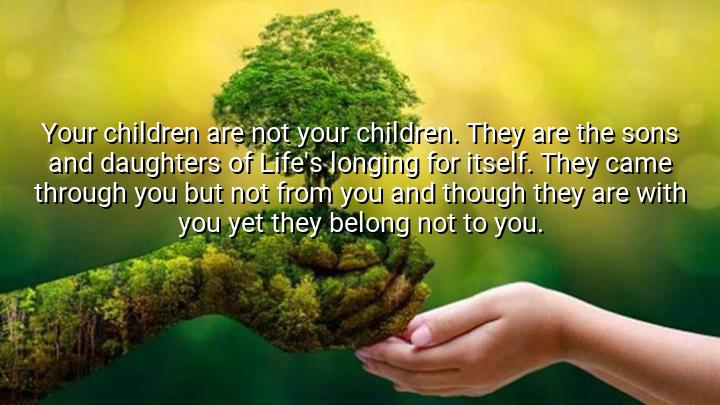




The quote "Your children are not your children. They are the sons and daughters of Life's longing for itself. They came through you but not from you and though they are with you yet they belong not to you." by Khalil Gibran conveys a deeply spiritual and philosophical understanding of parenthood and the nature of life itself. Gibran suggests that children are not possessions of their parents, but rather unique expressions of a greater force—Life—that seeks to continue, evolve, and manifest its essence through new beings. This view challenges conventional notions of ownership and control in parent-child relationships, promoting a sense of humility and reverence for the individual path of each child.
Khalil Gibran, a Lebanese-American poet, philosopher, and artist, wrote this passage in his famous 1923 book The Prophet. The book is a collection of poetic essays, and this quote comes from the chapter titled "On Children", where Gibran shares his views on the sacred responsibility of raising children. His writing blends mysticism, wisdom, and lyrical beauty, often drawing from both Eastern and Western spiritual traditions to express universal truths about human existence and love.
The phrase "they came through you but not from you" underscores the idea that while parents are the channels through which life emerges, they are not the source of their children’s identity, purpose, or destiny. This distinction encourages parents to see their role not as owners or molders, but as guides and guardians, respecting their children’s autonomy and encouraging their growth in alignment with their own inner calling. Gibran honors the individuality of each child as something sacred and not to be shaped solely by parental will.
Ultimately, this quote is a profound reminder of the spiritual nature of parenting—one that requires love without attachment, support without control, and presence without possession. Gibran’s words continue to resonate with parents, educators, and spiritual seekers, offering a vision of parenthood that honors both the sacred bond and the freedom necessary for a soul to flourish. It is a timeless piece of wisdom that invites us to view children as gifts of life itself, entrusted to us, but never truly ours to claim.

AAdministratorAdministrator
Welcome, honored guests. Please leave a comment, we will respond soon