

If a country is to be corruption free and become a nation of beautiful minds, I strongly feel there are three key societal members who can make a difference. They are the father, the mother and the teacher.
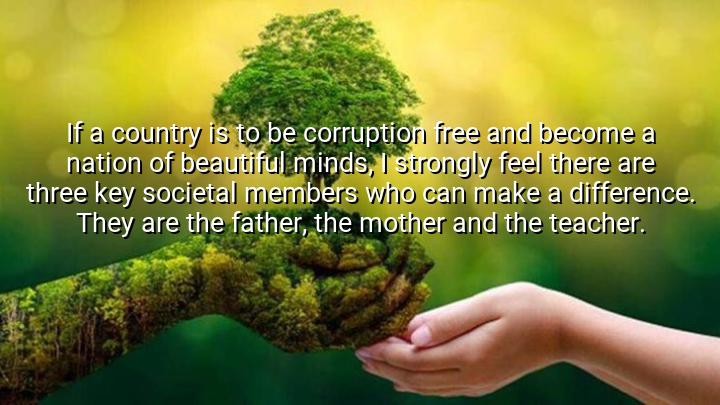




The quote "If a country is to be corruption free and become a nation of beautiful minds, I strongly feel there are three key societal members who can make a difference. They are the father, the mother and the teacher." by A. P. J. Abdul Kalam highlights the essential role of family and education in shaping a morally strong and intellectually vibrant society. Kalam believed that the foundation of a corruption-free nation lies not solely in politics or economics, but in the early values instilled in individuals by their parents and teachers. These three figures—the father, the mother, and the teacher—serve as the first and most influential mentors in a person's life.
A. P. J. Abdul Kalam, the former President of India and a renowned scientist and educator, was deeply committed to the idea of nation-building through character development. Throughout his speeches and writings, he consistently emphasized the power of education, discipline, and moral responsibility. This quote comes from his many public addresses aimed at inspiring youth and encouraging citizens to contribute positively to the future of India. His words reflect his belief that character and integrity begin at home and are nurtured in classrooms.
By naming the father, mother, and teacher as the pillars of change, Kalam underscores the importance of early influence and moral guidance. These figures are entrusted with shaping not just knowledge but also values, ethics, and a sense of civic duty. If these societal members act with integrity and commitment, they can raise generations of honest, creative, and compassionate citizens who will resist corruption and contribute to a better world.
Ultimately, Kalam’s quote is a call to empower the foundational roles in every society. It shifts the responsibility for national progress from government officials to everyday individuals who mold the minds of the young. His vision of a "nation of beautiful minds" can only be realized when families and educators work together to instill principles of truth, respect, and service in every child.

AAdministratorAdministrator
Welcome, honored guests. Please leave a comment, we will respond soon