

Woman is a ray of God. She is not that earthly beloved: she is creative, not created.
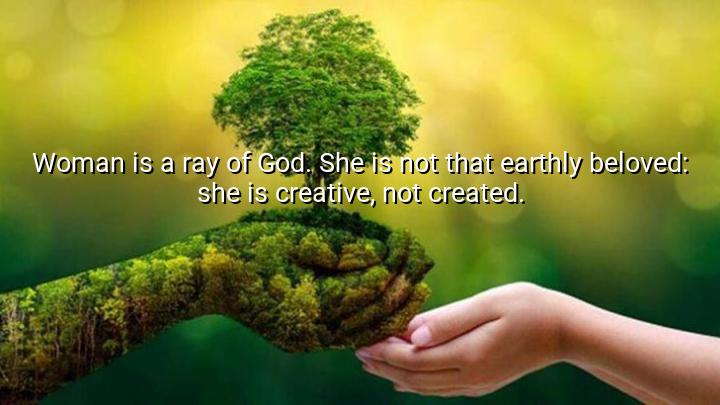




The quote "Woman is a ray of God. She is not that earthly beloved: she is creative, not created" by Rumi speaks to the spiritual and divine essence of women. Rumi, a 13th-century Persian poet and mystic, often used metaphors and deep spiritual language to explore the relationship between the divine and the earthly. In this quote, he elevates the woman beyond physical appearance or societal roles, portraying her as a divine entity with a connection to the higher realms of creation.
Rumi highlights that a woman is not just an earthly beloved, as commonly portrayed in literature and culture, but rather a manifestation of divine creativity. The term "ray of God" suggests that she carries within her a part of the divine light and is an expression of God's will and energy. This view aligns with Rumi's broader philosophy of divinity being present in all aspects of life, including humanity, and particularly within the feminine.
The quote emphasizes that woman is inherently creative, suggesting that she is a source of life and inspiration, not something that is simply formed or created by another. Rumi elevates her role, giving her a spiritual and creative agency that transcends the traditional view of women as passive or subordinate figures. In this sense, he challenges conventional ideas and celebrates the divine feminine as a force of creativity and power.
The origin of this quote lies in Rumi's broader mystical teachings, where he often explored the themes of love, creation, and the nature of the divine. Through his poetic verses, he expressed the belief that everything in the universe, including woman, is a reflection of the divine and holds an intrinsic connection to the creative force of God. This view has inspired countless interpretations of feminine spirituality and the sacred role of women in many cultures.

AAdministratorAdministrator
Welcome, honored guests. Please leave a comment, we will respond soon