

Without culture, and the relative freedom it implies, society, even when perfect, is but a jungle. This is why any authentic creation is a gift to the future.
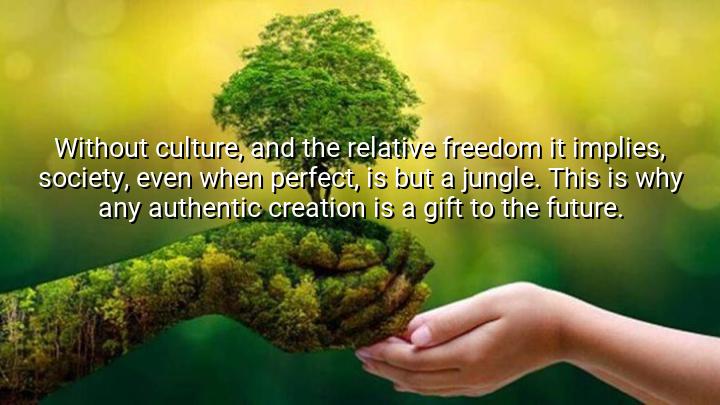




Albert Camus’ quote highlights the crucial role that culture and freedom play in shaping a truly civilized society. He argues that without culture, even a society that appears perfect on the surface is merely a "jungle"—a chaotic and untamed environment, devoid of deeper meaning and human connection. Culture, in Camus’ view, is what brings order, beauty, and purpose to human life, elevating it beyond mere survival and creating a space for individuals to express their identity and values.
The idea of freedom is also central to the quote. Camus suggests that cultural expression can only thrive in an environment that allows for relative freedom—where individuals are free to think, create, and challenge norms. Without such freedom, the richness of human experience and expression is stifled, reducing society to a basic, instinctual existence. For Camus, the ability to create and express oneself is an essential part of what it means to live in a civilized world.
In the second part of the quote, Camus asserts that authentic creation—whether in art, ideas, or social structures—is a gift to the future. These creations transcend their immediate context, offering lasting value that enriches future generations. By contributing to culture and freedom, authentic works create a legacy that shapes the future, offering new perspectives, fostering dialogue, and preserving the ideals that define humanity.
Ultimately, Camus’ quote emphasizes that without culture and freedom, human society risks descending into a primitive and disconnected state. True civilization, according to him, is built on the ability to create and freely express ideas, ensuring that each authentic creation is a meaningful contribution to the betterment of society and the human experience.

AAdministratorAdministrator
Welcome, honored guests. Please leave a comment, we will respond soon