

With increasing age, dullness of mind and heart sets in.
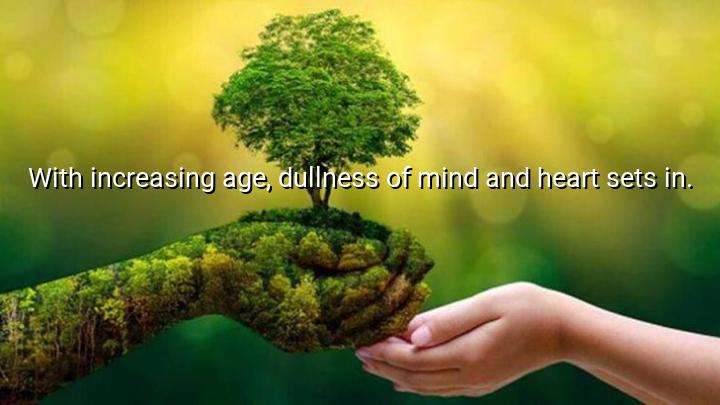




In this quote, Jiddu Krishnamurti, an influential philosopher and spiritual teacher, expresses the belief that as people grow older, they may experience a dullness of mind and heart. He suggests that aging often leads to a decline in both mental and emotional vitality, making individuals less engaged with life, less curious, and less capable of experiencing deep emotional connections. This dullness could be a result of routine, repetition, or a growing disconnection from the present moment.
Krishnamurti's statement reflects his view on human consciousness and the effects of time on an individual’s ability to remain open, engaged, and mentally sharp. He believed that as people age, they might become more set in their ways and less open to new experiences or ideas, leading to a stagnation in both their thoughts and emotions. This idea ties into his larger philosophy of the need to remain mindful and aware, regardless of age, in order to prevent the mental and emotional decay that he describes.
The quote also speaks to the limitations of age, particularly when it comes to personal growth. Krishnamurti may be commenting on how aging can lead to a sense of complacency, where individuals stop actively questioning their surroundings, seeking new insights, or engaging deeply with others. He implies that without constant mental exercise and emotional awareness, people risk losing the vitality and clarity that are necessary for a full, rich life.
Ultimately, Jiddu Krishnamurti’s quote challenges the idea that aging inevitably leads to dullness and decline. While acknowledging that age can bring limitations, he calls for continued mental and emotional engagement throughout life. His message serves as a reminder that it is possible to maintain a sharp mind and an open heart at any age, as long as one remains aware and committed to personal growth and learning.

BHVu Ngoc Bao Han
There’s something haunting about this idea — that our senses, emotions, and thoughts dull over time. But is it nature or nurture? I think we need to ask how society contributes to this decline. Are elders encouraged to stay mentally and emotionally active, or are they subtly pushed into silence and passivity? This makes me wonder what personal and cultural practices can help keep our hearts and minds vibrant as we grow older.
VTDuong Van Tuan
I want to push back against this quote. It feels too fatalistic. Sure, aging brings physical and sometimes mental decline, but does that necessarily mean emotional dullness too? I've seen older people fall in love, create beautiful work, and stay passionately engaged with the world. Maybe dullness happens when we disconnect from wonder — and that can happen at any age. So what keeps us connected to curiosity and feeling?
MNNgoc Huyen My Nguyen
Krishnamurti’s observation stings a bit, but I think it raises a good question: what habits or beliefs cause our inner life to fade as we age? Is it the fear of change, the comfort of routine, or the pain of loss that leads to this dullness? Maybe this is a call to keep questioning, keep exploring, and not fall asleep inside ourselves just because our bodies are aging.
MLNguyẽn MY linh
This quote makes me ask whether dullness is inevitable or something we unconsciously choose. Do we stop seeking out new experiences and ideas because age makes us tired, or because society tells us we’re past our prime? I’d love to hear stories from people who’ve actively resisted this dullness — artists, learners, even spiritual seekers — who’ve kept their hearts and minds sharp well into old age.
TNTruc Nguyen
I find this perspective troubling. Does aging really have to bring dullness of mind and heart? I’ve met older individuals who are full of life, imagination, and warmth. Could this dullness come more from societal neglect or internal resignation than from age itself? I wonder if Krishnamurti is offering a warning rather than a conclusion — maybe he's challenging us to stay awake and emotionally present as we grow older.