

I maintain that Truth is a pathless land, and you cannot approach it by any path whatsoever, by any religion, by any sect.
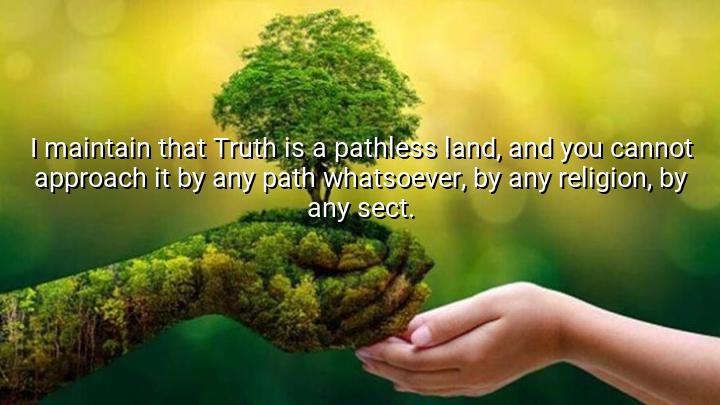




In this quote, Jiddu Krishnamurti asserts that Truth is not something that can be found through conventional means such as religion, sects, or any specific path. He describes Truth as a pathless land, suggesting that it cannot be approached through rigid structures, ideologies, or doctrines. For Krishnamurti, the search for truth is a deeply personal and individual process, one that cannot be dictated by external authorities or prescribed systems. This perspective challenges the common notion that truth can be understood by following a prescribed set of beliefs or practices.
Krishnamurti’s rejection of organized systems—whether religious or philosophical—stems from his belief that these frameworks often limit freedom and self-discovery. He argues that when people follow a path laid out by others, they are merely adopting a preconceived view of truth rather than experiencing it for themselves. In this way, he emphasizes personal insight and direct perception as the only true means of understanding reality. Truth, according to Krishnamurti, is not something external to be grasped, but an internal realization that transcends cultural and religious barriers.
This statement is deeply rooted in Krishnamurti’s philosophy of freedom and non-attachment. Born in 1895 in British India, Krishnamurti was groomed by the Theosophical Society to be a spiritual leader, only to reject this role later in life. His rejection of religious dogma and institutionalized belief systems grew from his personal experiences and his conviction that true understanding can only arise when one is not bound by tradition or external influences. Krishnamurti believed that real freedom comes from breaking free of these conditioning forces.
Krishnamurti’s idea of a pathless land also speaks to the fluidity of truth itself. In his view, truth is not static or fixed; it’s a living, evolving experience that can’t be constrained by any singular ideology or method. For him, the pursuit of truth requires a mind that is free from prejudices, assumptions, and expectations—a mind that is open and receptive to the present moment, unclouded by past experiences or external teachings.

AAdministratorAdministrator
Welcome, honored guests. Please leave a comment, we will respond soon