

Wisdom is a gift but has nothing to do with age. That was probably the case with me.
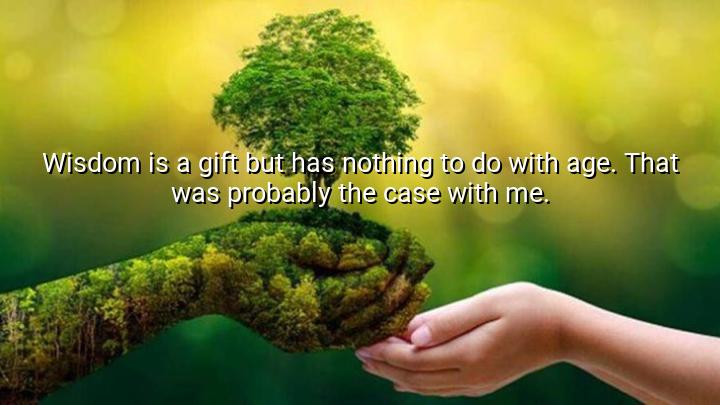




Ruby Bridges’ quote emphasizes the idea that wisdom is not necessarily linked to age, but rather is a gift that can be possessed by individuals regardless of how many years they’ve lived. By stating, "Wisdom is a gift but has nothing to do with age," Bridges challenges the common belief that wisdom is gained purely through the passage of time or life experience. She suggests that wisdom can come in many forms and may not always be tied to age or seniority.
When Bridges adds, "That was probably the case with me," she reflects on her own personal journey, acknowledging that her own wisdom did not stem from age but from the experiences she had at a very young age. As a civil rights activist who, at just six years old, became the first African American child to attend an all-white elementary school in the American South, Bridges was exposed to extraordinary challenges and difficult situations that required a level of maturity and understanding beyond her years.
Bridges’ statement points to the idea that wisdom can emerge in response to specific circumstances or struggles, rather than simply accumulating with age. Her own experience of navigating the racial tensions and hostility during the integration of schools in the 1960s likely shaped her ability to demonstrate courage, empathy, and insight, qualities that are often associated with wisdom but are not confined to older individuals.
Ultimately, Ruby Bridges’ quote reminds us that wisdom is not solely the domain of the elderly or those with extensive life experiences. It highlights how younger individuals, especially those who face unique challenges, can develop profound wisdom and insight well before reaching old age, as their life experiences shape them in meaningful ways.

TDTruc Dao
There’s something quietly profound about the humility in this statement. It makes me curious—how much of wisdom is tied to self-awareness and the ability to act with empathy or courage, regardless of age? Ruby Bridges clearly had to navigate complex moral and emotional landscapes as a child. Does that mean wisdom can be more situational than cumulative, emerging when someone is called to rise above the ordinary?
TPThao Phuong
I appreciate this perspective because it challenges the stereotype that wisdom only comes with age. But I also wonder: how do you differentiate between precociousness and genuine wisdom? Can someone really possess wisdom without the benefit of time to process and reflect on what they've learned? Or is it possible that wisdom sometimes comes in moments of clarity even without a long timeline of experience?
PDPhuong Do
The quote raises a fascinating point: is wisdom more about lived intensity than lived duration? Bridges experienced immense social and emotional challenges early in life—things most adults never face. So maybe it's not just age that develops wisdom, but the gravity of what you endure. If that’s the case, should we be redefining how we measure wisdom, especially in young people who’ve been through extreme life experiences?
UPUyen Phuong
I find this idea incredibly powerful, especially coming from someone like Ruby Bridges, who was thrust into a historically pivotal role at such a young age. It makes me wonder—how do we create space to honor the voices of young people who show remarkable maturity or clarity? Can society better nurture these early sparks of wisdom rather than waiting for age to validate someone's perspective?
NKNguyen Nam Khanh
This statement really makes me think about how we define and recognize wisdom. Is it something innate, or can it be cultivated through experience and reflection? Ruby Bridges went through extraordinary circumstances as a child, so perhaps those experiences demanded a kind of wisdom most people never need to develop so young. Do we underestimate children’s capacity for deep insight simply because of their age and perceived innocence?