

We have tolerance, respect, and equality in our written laws but not in the hearts of some of our people.
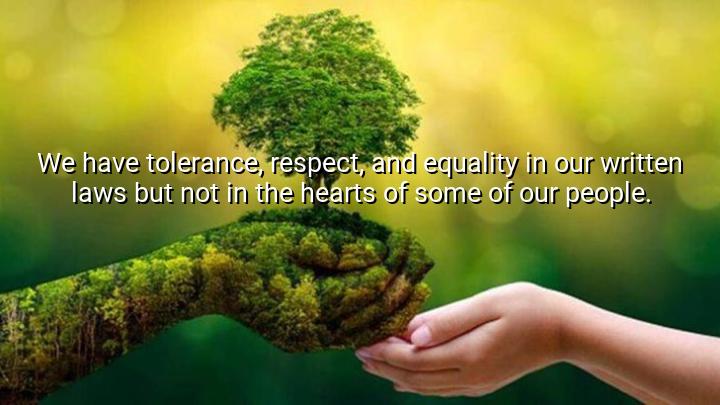




In this quote, Ruby Bridges points out the gap between the ideals enshrined in written laws and the realities of how those ideals are applied in everyday life. She acknowledges that tolerance, respect, and equality are present in the legal system, yet, she stresses that these values do not always reflect the attitudes or behaviors of some individuals in society. Bridges highlights the distinction between formal legal rights and the more personal, internalized aspects of social change.
Bridges suggests that, while laws may guarantee equality on paper, true acceptance and respect can only be achieved when people internalize these values and allow them to guide their actions and interactions with others. The discrepancy she points to is often visible in discrimination and prejudices that persist despite legal protections. Her statement challenges the idea that the passing of laws automatically results in a more just society, urging that cultural and attitudinal change is also necessary for true social equality.
The phrase "not in the hearts of some of our people" implies that, despite legal advancements, hate, bias, and intolerance still exist at a personal level. Bridges calls attention to the human element in the struggle for civil rights, suggesting that laws alone cannot eradicate social injustice if they are not coupled with genuine empathy, understanding, and a commitment to treating others with respect.
Ultimately, Bridges' quote underscores the importance of both legal reform and personal transformation in the pursuit of equality. It serves as a reminder that lasting change requires a collective effort to move beyond legal equality to an inclusive society where tolerance and respect are genuinely felt and practiced by all individuals.

AAdministratorAdministrator
Welcome, honored guests. Please leave a comment, we will respond soon