

Why should society feel responsible only for the education of children, and not for the education of all adults of every age?
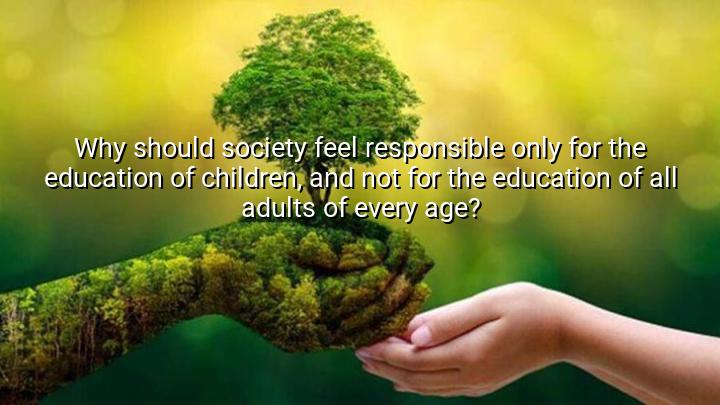




In this quote, Erich Fromm challenges the common societal belief that education is primarily the responsibility of institutions for children and young people. Fromm argues that society should not limit its responsibility to the education of the younger generation but should extend that responsibility to adults of every age. His question raises awareness about the ongoing importance of learning and growth throughout one’s life, emphasizing that education should be a lifelong pursuit and not confined to childhood or adolescence.
Fromm’s statement highlights the concept of continuous education and the idea that learning does not stop when one reaches adulthood. He critiques the societal assumption that once people reach a certain age, their capacity for learning diminishes or becomes irrelevant. Fromm suggests that adults should also be encouraged to pursue knowledge, develop critical thinking skills, and expand their intellectual and emotional horizons. In this way, the education of adults is just as vital for a healthy, progressive society as that of children.
The quote also touches on the broader notion of social responsibility. Fromm believes that society should invest in the intellectual and emotional development of all its members, not just the young. This view aligns with his broader philosophy of humanism and the need for people to grow into more aware, compassionate, and reflective individuals. By emphasizing the education of adults, Fromm advocates for a more inclusive approach to personal and societal development, where learning is valued at every stage of life.
Ultimately, Erich Fromm is calling for a paradigm shift in how society views education. Rather than seeing it as a phase of life that ends after childhood, he advocates for the recognition that education is an ongoing, essential process for all people, regardless of their age. His quote encourages a more holistic view of human development, where the responsibility for learning extends throughout one’s entire life.

HPThi Huyen Pham
I’ve seen firsthand how many adults feel left behind, especially those who didn’t have access to quality education early in life. Why does society act like once you turn 18, you’re on your own in terms of learning? Isn’t it more humane—and more effective—to foster continuous learning, particularly when it can combat inequality and improve social cohesion in communities?
QABui Quynh Anh
This quote really challenges the way we view responsibility in education. It makes me wonder: Is our education system truly built for personal growth, or just to produce workers for the economy? Adults are often left to self-educate or rely on expensive programs. Wouldn’t a more inclusive educational model—one that spans a lifetime—create a more resilient, adaptable, and empathetic society?
4T4E Thao
Isn’t this idea especially relevant today, when so many adults are navigating industries transformed by technology? If society expects people to stay productive and informed, shouldn’t it also provide accessible education beyond youth? I think there’s still stigma around adult learners—as if going back to school means you failed before. How do we change that mindset and make education at any age both normalized and celebrated?
ANHai Anh Nguyen
I completely resonate with this quote. It highlights a systemic blind spot—why is it assumed that learning ends at a certain age? Adults face complex life challenges that formal education could help address, like career changes, parenting, mental health, or aging. Wouldn’t more robust adult education programs benefit society as a whole, from increased civic engagement to better workplace productivity and overall well-being?
TMThuy Mai
This is such a thought-provoking question. We often associate education with childhood and forget that adults, too, need structured learning—especially in a rapidly changing world. Why isn’t lifelong education treated as a basic public good? With issues like technological shifts, civic responsibility, and personal growth at stake, shouldn’t society prioritize adult education just as much as it does schooling for children?