

In love the paradox occurs that two beings become one and yet remain two.
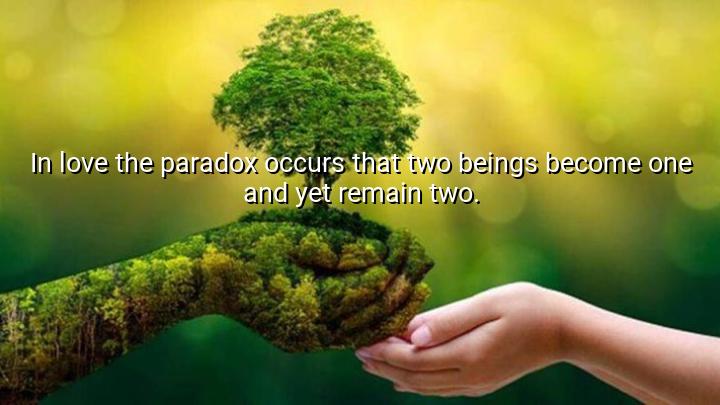




The quote "In love the paradox occurs that two beings become one and yet remain two" by Erich Fromm highlights the complexity and duality inherent in the experience of love. Fromm suggests that love creates a profound connection between two individuals, so much so that they feel as if they are united—as if they are one entity. Yet, despite this closeness, they each retain their individuality, and the essence of their separate selves continues to exist. Love, in this view, is both an act of merging and a respect for personal identity.
Erich Fromm, a 20th-century German social psychologist and philosopher, explored human emotions, relationships, and the nature of love in his influential works, including The Art of Loving. Fromm saw love as a dynamic and complex force that nurtures both unity and independence. He believed that true love is not about losing oneself in another, but rather about developing a mutual respect and recognition of each other’s uniqueness while fostering a deep, shared connection.
The paradox Fromm mentions underscores that in genuine love, there is an interdependence that doesn’t erase the boundaries between individuals. Rather, it allows both people to grow and flourish while remaining distinctly themselves. This balance between merging and maintaining separate identities is what makes love both transformative and sustaining. It’s not about merging into a single entity but about harmonizing with another person while keeping one’s individual soul intact.
Ultimately, Fromm’s words reveal the dynamic nature of love as a balancing act—a relationship that nurtures both unity and personal identity. Love doesn’t demand the obliteration of individuality; instead, it thrives on the interplay between oneness and separateness, where two people become deeply connected yet continue to live as distinct, autonomous beings.

AAdministratorAdministrator
Welcome, honored guests. Please leave a comment, we will respond soon