

Who am I? Not the body, because it is decaying; not the mind, because the brain will decay with the body; not the personality, nor the emotions, for these also will vanish with death.
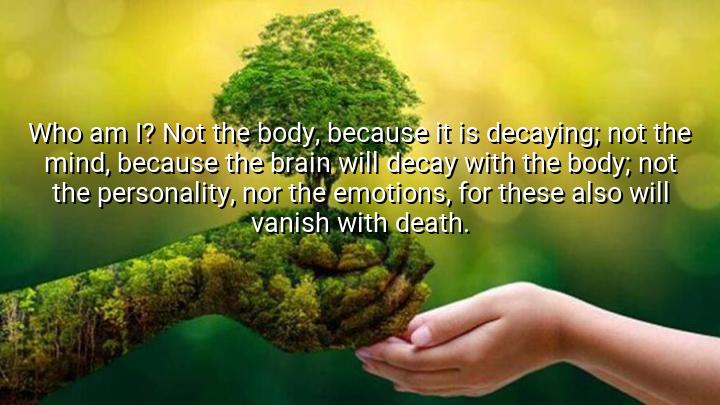




Ramana Maharshi’s quote, "Who am I? Not the body, because it is decaying; not the mind, because the brain will decay with the body; not the personality, nor the emotions, for these also will vanish with death," challenges the conventional ways we define our identity. Maharshi suggests that our true self cannot be equated with the physical body, the mind, or the emotional and personality traits that we associate with ourselves. All of these are transient and impermanent, subject to decay and death, and thus cannot be the essence of who we truly are. By distancing ourselves from these aspects, he invites us to contemplate a deeper, more lasting sense of identity.
This quote is central to Maharshi's spiritual teachings, particularly his emphasis on the self-inquiry process. His most famous question, "Who am I?" is a tool to explore the true nature of the self, beyond the illusions of body and mind. Maharshi advocates for turning inward and seeking the eternal aspect of consciousness that transcends the physical and mental dimensions. The body, the mind, and the emotions are seen as temporary aspects that cover the true nature of the self, which is unchanging and imperishable.
The essence of the quote is rooted in advaita philosophy, which teaches the non-duality of the self. According to this philosophy, the self is beyond physical and mental constructs; it is the pure consciousness or awareness that underlies all of existence. By recognizing that the body, mind, and emotions are not the true self, Maharshi encourages individuals to go beyond these external layers to discover the eternal nature of their being, which is unbounded and beyond death.
The origin of this quote comes from Ramana Maharshi, an Indian sage known for his profound teachings on self-realization and the nature of existence. Maharshi’s spiritual path centered on the practice of self-inquiry (known as Atma Vichara) as a means to realize one's true self. His teachings continue to inspire countless seekers, emphasizing that the true self is not the transient parts of identity, but the universal consciousness that pervades all of existence. This quote encapsulates his fundamental belief in the nature of the self as eternal and beyond the limitations of the physical world.

AAdministratorAdministrator
Welcome, honored guests. Please leave a comment, we will respond soon