

The mind itself is of the form of all, i.e., of soul, God and world; when it becomes of the form of the Self through knowledge, there is release, which is of the nature of Brahman: this is the teaching.
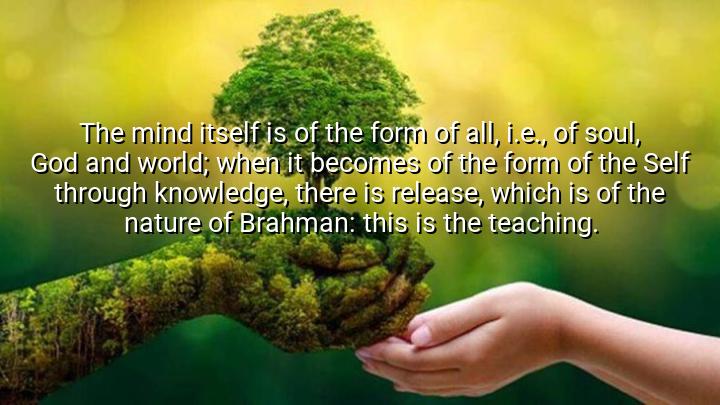




The quote by Ramana Maharshi delves into the philosophical and spiritual concept of Self-realization. He asserts that the mind inherently reflects all existence—it embodies the soul, God, and the world. This perspective highlights the interconnectedness of consciousness, divinity, and the universe, suggesting that the mind is a microcosm of all that exists.
Maharshi explains that through knowledge, the mind can transform and align with the Self. This process of understanding and inner realization allows one to transcend limited perspectives and identify with the eternal and universal aspects of existence. It emphasizes the role of self-awareness and introspection in achieving spiritual growth.
The quote also refers to release, which is described as being of the nature of Brahman, the ultimate reality in Hindu philosophy. This release, or liberation, is the result of the mind transcending ego and illusion to recognize its unity with the divine. The teaching underscores that true freedom comes from inner knowledge and realization, not external accomplishments or material gain.
Originating from Ramana Maharshi, a renowned Indian sage and proponent of Advaita Vedanta, the quote reflects his emphasis on self-inquiry and meditation as paths to spiritual awakening. Maharshi’s philosophy teaches that knowledge of the Self is the gateway to liberation, and that understanding the mind’s true nature allows one to experience the eternal reality of Brahman.

AAdministratorAdministrator
Welcome, honored guests. Please leave a comment, we will respond soon