

The body dies, but the spirit that transcends it cannot be touched by death.
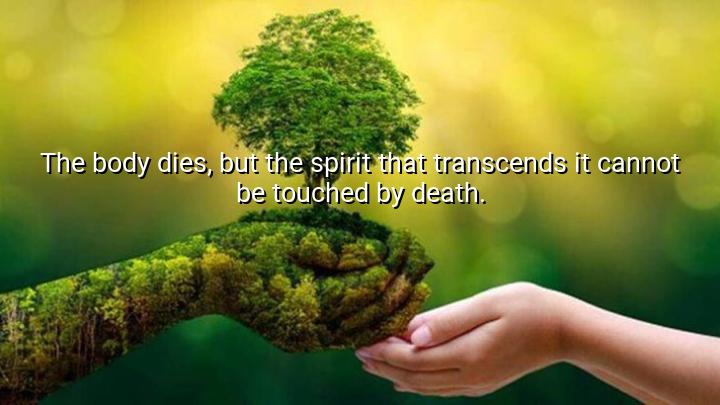




The quote, "The body dies, but the spirit that transcends it cannot be touched by death," is attributed to Ramana Maharshi, the Indian sage and spiritual teacher renowned for his teachings on self-inquiry and the nature of the Self. In this statement, Ramana distinguishes between the physical body, which is subject to decay and death, and the spirit or true Self, which is eternal and beyond the reach of mortality. He emphasizes that while the body is impermanent, the essence of who we are—the consciousness that transcends form—cannot be destroyed.
This perspective aligns with the Advaita Vedanta philosophy that Maharshi often taught, which asserts that the true Self is not the body or mind but pure awareness, untouched by birth or death. By pointing out the distinction between the transient body and the eternal spirit, Maharshi encourages seekers to identify with the Self rather than the physical form, leading to liberation from fear of death. The spirit, in his view, is beyond all suffering and change, and recognizing this truth is the heart of spiritual realization.
The origin of this quote can be traced to Ramana Maharshi’s many dialogues with his disciples, where he often reassured them about the nature of death and liberation. He taught that fear of death arises only when one wrongly identifies with the body. Through self-inquiry—asking “Who am I?”—one can discover the eternal consciousness that is untouched by physical mortality. His teachings, recorded in works like Talks with Sri Ramana Maharshi and Be As You Are, consistently return to this theme of the eternal spirit.
Ultimately, Maharshi’s words are meant to dissolve the fear of death by shifting perspective from the perishable to the imperishable. By realizing that the spirit is beyond the body, one can approach life and death with equanimity, understanding that while forms come and go, the essence of existence remains untouched. This insight provides both comfort and clarity for spiritual seekers on the path to self-realization.

AAdministratorAdministrator
Welcome, honored guests. Please leave a comment, we will respond soon