

When I passed the age of 50, I learned how to control my emotions.
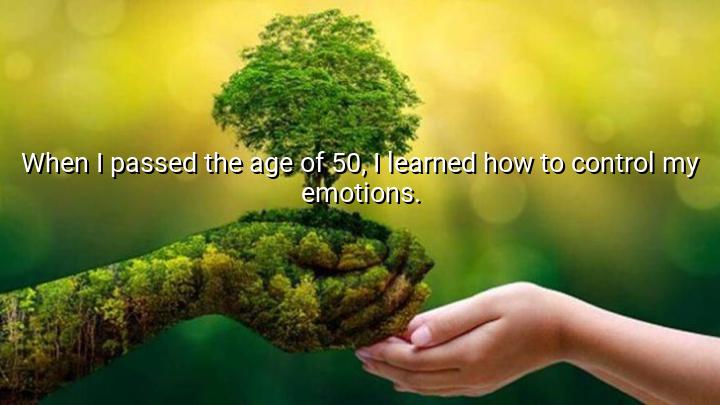




The quote "When I passed the age of 50, I learned how to control my emotions," by Mahmoud Darwish, reflects a personal realization about the wisdom and emotional growth that often comes with age. Darwish, a renowned Palestinian poet, is known for his deep reflections on life, identity, and the human experience. In this quote, he suggests that with the passing of time, especially after 50, he gained a better understanding of how to manage his emotional responses, which is a common aspect of maturity.
The idea of controlling emotions as one grows older speaks to the development of emotional intelligence. As people age, they often experience more life challenges and gain insight into how to handle them. Darwish implies that with age comes a deeper sense of self-awareness and self-discipline, which allows for more measured reactions rather than impulsive emotional responses. It’s a reminder that emotional control is a learned skill that improves with experience.
The significance of the age of 50 in the quote represents a milestone in a person's life, often associated with reflection and inner growth. Darwish suggests that, by this point, he had reached a level of maturity where he no longer allowed his emotions to dictate his actions. Instead, he had mastered the art of balance, learning to be more composed and thoughtful in his responses to life's difficulties.
This quote also highlights Darwish's personal journey and the universal truth that as people age, they often gain more control over their reactions and feelings. Through this wisdom, Darwish is encouraging others to embrace the emotional growth that comes with age. It’s a message of empowerment, showing that emotional stability can be attained through experience and reflection, particularly as we age and gain more perspective on life.

DRDuyen Rom
Reading this, I can’t help but ask: what kind of emotions is he referring to—anger, grief, fear, love? And what does 'control' mean in a poet’s world? Darwish lived through exile and conflict, so maybe his emotional journey is shaped by survival as much as by aging. Can art and pain accelerate emotional maturity, even more than age? Or is it only with time that we learn to carry our feelings without being carried away by them?
NTKhanh Huyen Nguyen Thi
Darwish’s words make me think of emotional control as a kind of earned wisdom, something that comes after years of struggle and reflection. But then again, is this a universal experience? I know plenty of older people who still react impulsively, and younger people who are incredibly emotionally grounded. Is it fair—or even accurate—to associate emotional control with age, or is that just a comforting narrative we tell ourselves?
GDGold D.dragon
This quote makes me think about how we define 'control.' Is it about suppressing emotions, channeling them, or simply understanding them more deeply? As someone who struggles with strong emotional responses, I find it hopeful that growth can come with time. But I also wonder—does controlling emotions mean we stop expressing them authentically? I’d love to hear how others interpret emotional control: as strength, discipline, wisdom, or maybe something else entirely.
C1Tieu chi 14
I’m curious—why 50? Is there something biologically or psychologically significant about that age that makes people better at handling emotions? Or is Darwish using that milestone symbolically, as a way to mark a deeper transition into a more reflective phase of life? I wonder how culture and life experience play into this idea. Does everyone experience this emotional shift, or is it unique to certain kinds of personal or artistic journeys?
MKNguyen Minh Khanh
This line hit me hard, especially as someone approaching midlife. There's something both comforting and a little sad in the idea that it takes decades to master your emotions. Does emotional control mean peace, or does it mean numbness? I'm torn—part of me longs for that balance, but part of me worries about losing the rawness that comes with feeling deeply. Is emotional control always a gain, or can it be a kind of loss too?