

When all the world is overcharged with inhabitants, then the last remedy of all is war, which provideth for every man, by victory or death.
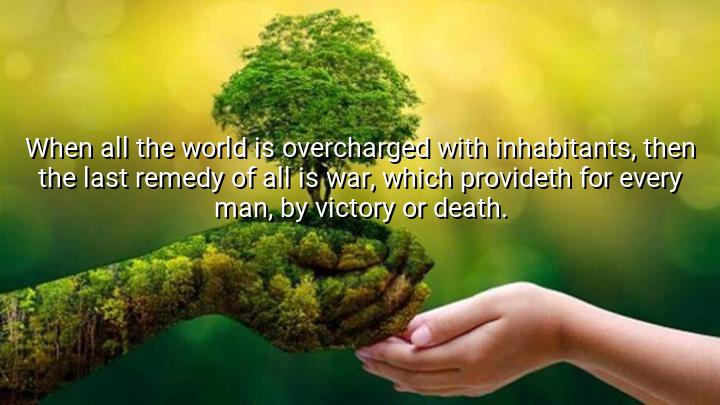




The quote "When all the world is overcharged with inhabitants, then the last remedy of all is war, which provideth for every man, by victory or death" by Thomas Hobbes reflects his bleak view of human nature and societal conflict. Hobbes, a 17th-century philosopher, is best known for his work Leviathan, where he explores the nature of human existence and the necessity of a strong governing authority to avoid chaos. In this quote, he suggests that when the world is overwhelmed with too many people, war becomes the ultimate solution, either through victory or death.
Hobbes argues that in a world where resources are scarce and competition for those resources intensifies, war becomes an inevitable outcome. When society's social contract breaks down, and the population grows beyond manageable limits, violence and conflict can arise as a means of restoring order or resolving the struggle for survival. The quote reflects Hobbes' pessimistic view that without a powerful central authority to enforce peace, humans are driven to violent solutions to their problems.
The notion that war is a remedy for overpopulation and societal tension underscores Hobbes' belief in the state of nature, a concept he used to describe the condition of humanity without political order. In this state, people are in constant conflict, driven by self-interest, and the only way to resolve such tensions, according to Hobbes, is through force. War, in this context, is portrayed as a necessary evil, a final recourse when all other options fail.
Hobbes' philosophy, while rooted in a very specific historical context, has influenced political theory and the way we think about power, governance, and human conflict. This quote highlights his belief in the inevitability of war when society lacks effective regulation, offering a sobering perspective on the potential consequences of unchecked population growth and resource depletion.

AAdministratorAdministrator
Welcome, honored guests. Please leave a comment, we will respond soon