

Fear of things invisible in the natural seed of that which everyone in himself calleth religion.
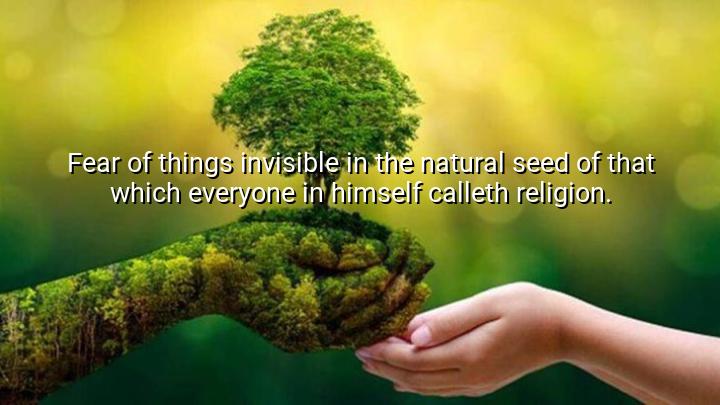




The quote by Thomas Hobbes explores the origins of religion, suggesting that it arises from fear of the invisible or unknown. Hobbes argues that humans naturally encounter uncertainty and phenomena beyond their understanding, and this fear gives rise to beliefs and practices that we collectively call religion. In this view, religion is fundamentally tied to human psychology and the instinctive need to explain and manage mysteries of the world.
The origin of this insight comes from Hobbes’ work as a 17th-century English philosopher, particularly in his writings on political philosophy and human nature, such as Leviathan. Hobbes often analyzed the foundations of society and human behavior, emphasizing the role of fear and self-preservation in motivating human action. He saw religion as emerging naturally from the mind’s attempt to make sense of the unknown and ensure security.
At its core, the quote conveys that religion is not purely about divine revelation or moral instruction but is rooted in the human response to uncertainty and invisible forces. Hobbes presents it as an intrinsic part of human nature—what “everyone in himself calleth religion”—arising spontaneously from internal anxieties and the desire for protection and understanding.
Ultimately, Thomas Hobbes’ words encourage a reflection on the psychological and social functions of religion. By framing it as a product of fear and the need to explain the unseen, he emphasizes the human tendency to create structures of belief and meaning, revealing the deep connection between human nature, fear, and the formation of religious systems.

AAdministratorAdministrator
Welcome, honored guests. Please leave a comment, we will respond soon