

The disembodied spirit is immortal; there is nothing of it that can grow old or die. But the embodied spirit sees death on the horizon as soon as its day dawns.
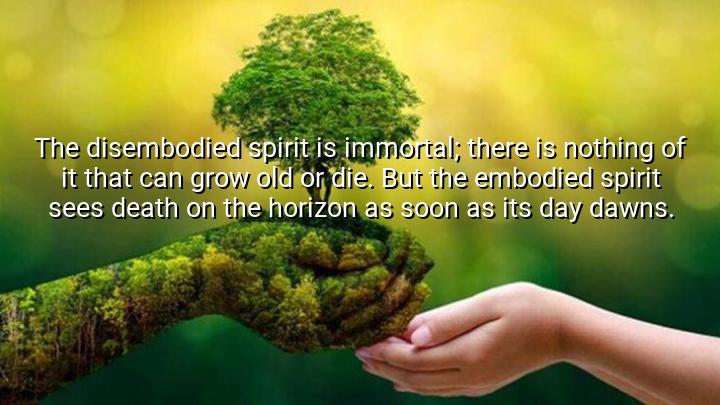




The quote "The disembodied spirit is immortal; there is nothing of it that can grow old or die. But the embodied spirit sees death on the horizon as soon as its day dawns" by Thomas Hobbes contrasts the eternal nature of the spirit with the mortality of the body. Hobbes suggests that the spirit, once separated from the physical form, is immortal and cannot be affected by the passage of time or death. However, the embodied spirit, which is still connected to the body, is inherently mortal and is always aware of its inevitable death, from the moment it begins life.
Hobbes' view reflects his materialist philosophy, where he often saw the mind and body as interconnected and bound by the limitations of physical existence. In this quote, he emphasizes that while the spirit—as an abstract or non-physical entity—might exist beyond time and decay, the human experience in its physical form is limited by death and aging. The embodied spirit faces the constant reminder of mortality, unlike the disembodied spirit that exists beyond the reach of time.
The origin of this quote comes from Thomas Hobbes, an English philosopher best known for his work on political theory and human nature. His most famous work, Leviathan, discusses the nature of society, government, and the human condition, where he argued that human beings are driven by self-interest and the need for survival. This quote reflects his broader thoughts on life, death, and the relationship between the mind and body.
Ultimately, Hobbes' quote reflects a philosophical perspective on the relationship between life, death, and the spirit. It invites us to consider the distinction between our physical existence, which is limited and bound to death, and the potential immortality of the spirit, which may transcend the physical form. The awareness of death, Hobbes suggests, is a fundamental part of the human experience, coloring how we understand our own existence and the fleeting nature of life.

AAdministratorAdministrator
Welcome, honored guests. Please leave a comment, we will respond soon