

What Youth deemed crystal, Age finds out was dew.
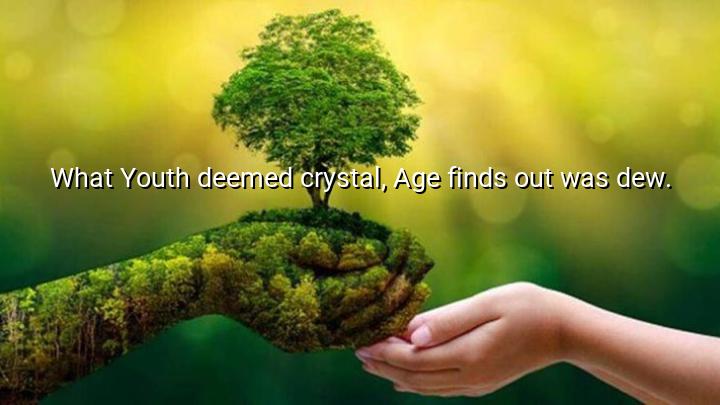




In this quote, Robert Browning explores the difference between the idealized perceptions of youth and the more realistic views of age. He uses the metaphor of crystal and dew to convey how youth often sees the world through a lens of perfection and clarity, imagining everything as lasting and immovable—like crystal. However, with the passage of time and the wisdom that comes with age, those once-idealized concepts are seen as fleeting and insubstantial, much like dew, which evaporates quickly. Browning suggests that the perceptions of youth are often naïve, and with experience, individuals come to understand the impermanence and fragility of things.
The quote also speaks to the theme of illusion versus reality. In youth, everything seems certain and ideal, but as we age and experience life’s complexities, we learn that many of our early beliefs were shaped by an idealism that does not align with the often unpredictable and transitory nature of life. The shift from crystal to dew symbolizes the transition from the belief in eternal or perfect things to the recognition of their temporary and impermanent nature.
Browning’s words can be interpreted as a reflection on the process of maturity. As we age, we gain a more grounded and pragmatic view of the world. The wisdom that comes with age allows us to see things more clearly, without the distortions of youthful idealism. This shift in perspective can be seen as a form of growth, where we learn to accept the fleeting nature of life and the impermanence of our earlier dreams and ambitions.
Ultimately, Robert Browning’s quote reminds us that youth often holds onto dreams and ideas that seem certain and permanent, but as we grow older, we come to understand the ephemeral nature of those beliefs. This realization can lead to a more balanced and mature approach to life, where we accept change and impermanence as natural aspects of the human experience.

TDLe Thi Thuy Duong
This quote sparks a question for me: is the clarity of age always superior to the optimism of youth? There’s something noble about seeing something as ‘crystal’ — unchanging, perfect — even if it isn’t. Does wisdom lie in seeing through illusions, or in embracing them for what they offer in the moment? Maybe both are necessary, and each has its own kind of truth.
VVuonghoaianh
I find this quote quietly devastating. It speaks to the erosion of certainty — how what once gleamed with clarity fades under the weight of experience. But maybe that’s the beauty of it. Dew is softer than crystal, after all. It’s more ephemeral, more real in its fleetingness. Is it better to see things clearly and transiently, or to hold onto illusions that give us a sense of permanence?
XBNguyen Xuan Bach
There's a wistfulness in this quote that I can’t shake. It’s like Browning is gently pointing out how time humbles us, shows us that what we thought was unbreakable was actually delicate. Is that a reason to be cynical, or to approach life with more tenderness? I find myself thinking about how I treat my present assumptions — will they, too, dissolve into dew one day?
MSMINH SON
This line really makes me reflect on the idea of value and perception. What youth sees as flawless and eternal, age sees more clearly — even humbly. But does that mean youth is wrong, or just viewing through a different lens? Sometimes the illusion itself holds value, even if it's not 'true.' I wonder how much of life’s meaning is built on things we eventually outgrow but still cherish in memory.
NLNguyen Ngoc Linh
I love how succinctly Browning captures the transformation of perspective over time. It makes me wonder: do we need the illusions of youth to fuel our dreams and take risks? Maybe age brings wisdom, but does it also rob us of the bold belief that things are as magical as they seem? I’m curious if there’s a way to keep both the clarity of age and the passion of youth alive together.