

We women are going to bring change. We are speaking up for girls' rights, but we must not behave like men, like they have done in the past.
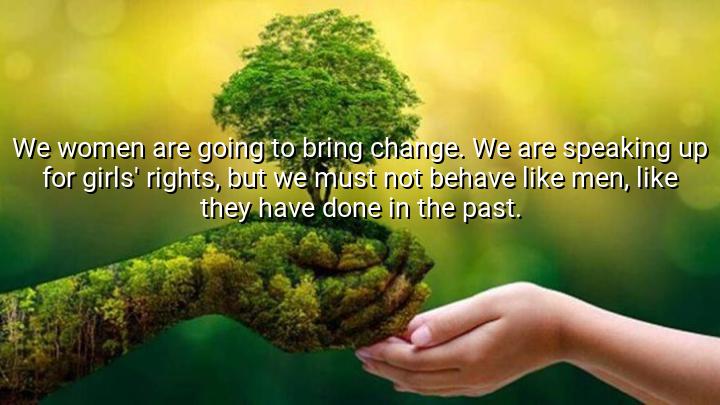




This quote by Malala Yousafzai reflects her commitment to gender equality and the empowerment of women, particularly in the context of girls’ rights. When she says, “We women are going to bring change,” she expresses confidence in the growing leadership and activism of women worldwide. Malala sees women as a powerful force for positive transformation, especially in the fight for education, freedom, and equal opportunity.
However, she adds a meaningful caution: “we must not behave like men, like they have done in the past.” This part of the quote is not a condemnation of all men, but a critique of historical patterns of power, where leadership has often been associated with dominance, violence, or oppression. Malala advocates for a different kind of leadership—one grounded in compassion, inclusivity, and justice, rather than simply replicating the flawed models of the past.
The origin of this quote lies in Malala Yousafzai’s role as a global advocate for girls’ education and the youngest recipient of the Nobel Peace Prize. After surviving an assassination attempt by the Taliban for speaking out on girls’ right to go to school, Malala became a symbol of resilience and a leading voice in the international movement for women’s rights. This quote reflects her vision of a future shaped by women, but one that is not defined by imitating past systems of male-dominated power.
Ultimately, Malala’s quote calls for transformational leadership, not duplication. She urges women to lead with values that prioritize equality, understanding, and empathy, showing that real change comes not just from who is in power, but how that power is used. It is a vision for a better, more balanced world—led by women, but driven by humanity.

AAdministratorAdministrator
Welcome, honored guests. Please leave a comment, we will respond soon