

I speak not for myself but for those without voice... those who have fought for their rights... their right to live in peace, their right to be treated with dignity, their right to equality of opportunity, their right to be educated.
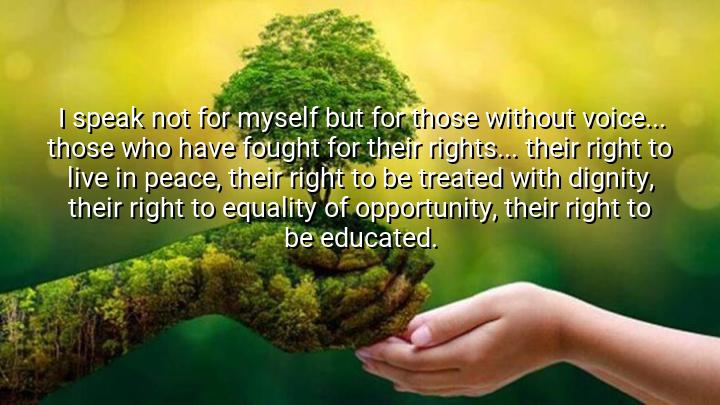




Malala Yousafzai’s quote, "I speak not for myself but for those without voice... those who have fought for their rights... their right to live in peace, their right to be treated with dignity, their right to equality of opportunity, their right to be educated," reflects her commitment to advocating for those who are marginalized or oppressed, especially in the realm of education and human rights. Malala emphasizes that her activism is not driven by personal gain, but by the desire to amplify the voices of those who have been denied basic human rights, particularly the right to education and the right to equality. Her focus is on the global struggle for dignity and peace, where many individuals are still fighting to have their voices heard and their rights recognized.
The quote highlights the core values that Malala stands for: peace, dignity, and equality of opportunity. By stating that she speaks for others, Malala positions herself as a champion of those who lack access to opportunities and are systematically oppressed. Her mention of the right to education is particularly significant, as it has been a central theme in her life’s work, especially after surviving an assassination attempt by the Taliban for advocating girls' education in Pakistan. In this statement, she extends her message to a broader group, not just girls, but all those who face oppression in various forms.
The origin of the quote is deeply rooted in Malala’s activism and her personal experiences as a young advocate for education. Malala first gained global recognition after surviving the 2012 attack and continuing to speak out for the rights of girls to receive an education, regardless of societal or political obstacles. She became the youngest-ever Nobel Peace Prize laureate in 2014 for her efforts, and her words here echo her ongoing fight for global education and gender equality. This quote exemplifies her belief that human rights are universal and that those without power or voice deserve to have their struggles highlighted.
Ultimately, Malala’s statement reinforces the idea that true leadership is not about personal fame, but about using one's platform to speak for those who have been silenced. Her work has transcended national borders, urging societies around the world to uphold the fundamental rights of all individuals, especially those who are denied the most basic of freedoms. Through her advocacy, she continues to inspire millions of people to fight for equality and the right to education.

AAdministratorAdministrator
Welcome, honored guests. Please leave a comment, we will respond soon