

In countries other than Pakistan - I won't necessarily call them 'Western' - people support me. This is because people there respect others. They don't do this because I am a Pashtun or a Punjabi, a Pakistani, or an Iranian, they do it because of one's words and character. This is why I am being respected and supported there.
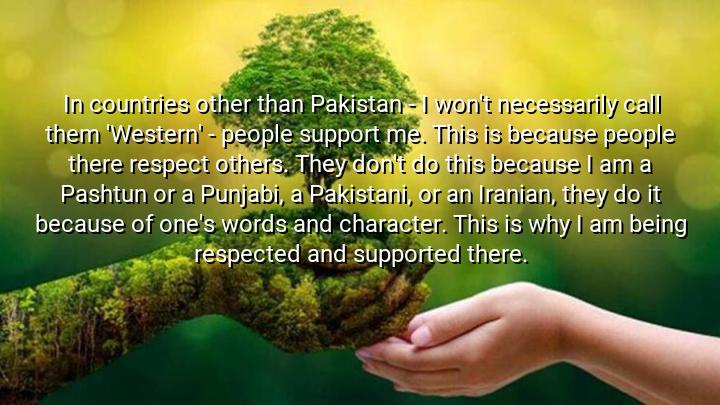




Malala Yousafzai’s quote highlights the universal importance of respect for character and ideas, rather than ethnic or national identity. She explains that her support in countries outside of Pakistan comes from a recognition of her words and character, rather than her ethnic background as a Pashtun or Punjabi, or her nationality as a Pakistani or Iranian. This distinction reflects a belief in the power of principles, integrity, and humanity to transcend borders and foster genuine connections across different cultures.
Malala’s statement also underscores the value of respect for others, which she identifies as a key reason why people in non-Pakistani, non-Western countries support her work. She contrasts this with the divisiveness that can arise from ethnic, religious, or national labels, suggesting that in places where respect is prioritized over identity, individuals are seen and appreciated for their humanity rather than their background. This reflects her commitment to global solidarity and human rights, where respect is given for one’s actions and ideas, not predetermined categories.
The origin of this quote lies in Malala’s advocacy for education and equality for girls and women worldwide. Despite the political and cultural challenges she faced in Pakistan, Malala has received global recognition for her activism, particularly for standing up against the oppressive forces that prevent girls from accessing education. Her words reflect her belief that personal character and values are what truly define a person, not the labels society often imposes.
Ultimately, Malala’s quote calls for a broader understanding of respect and solidarity. It suggests that people who are judged by their character and words—rather than by their ethnic group or nationality—are more likely to inspire global support. In a world that often emphasizes differences, her message advocates for unity based on shared values, mutual respect, and a commitment to human dignity.

AAdministratorAdministrator
Welcome, honored guests. Please leave a comment, we will respond soon