

We live in an age of technology and science that demands proof, and yet we desire mystery. But when God gives us mystery, we seek to destroy it by gross indifference or childish reasoning.
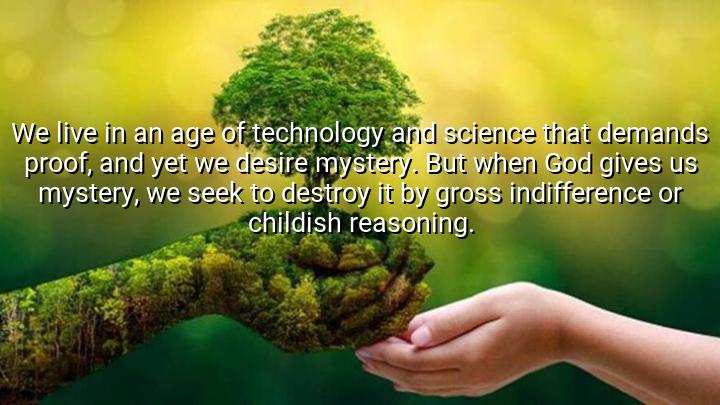




Mother Angelica’s quote, "We live in an age of technology and science that demands proof, and yet we desire mystery. But when God gives us mystery, we seek to destroy it by gross indifference or childish reasoning," addresses the paradox between humanity’s need for concrete evidence in a world driven by science and the natural human inclination to be captivated by mystery and the unknown. She highlights the tension between the scientific quest for proof and the spiritual or emotional desire for mystery, which is often associated with faith, wonder, and the deeper questions of existence.
The quote also critiques how, when faced with mystery—particularly the kind that can be linked to the divine or spiritual realms—humankind often responds with either indifference or simplistic, childish reasoning that seeks to dismiss or overly rationalize that mystery. Instead of embracing the unknown as part of the spiritual or existential experience, we try to break it down and "destroy" it with our desire to control or fully understand it. This reflects a deep irony: the very things that give life depth and meaning, such as faith and mystery, are often pushed aside in favor of rationality and immediate answers.
Mother Angelica, a Catholic nun and founder of the EWTN (Eternal Word Television Network), was known for her outspoken views on spirituality and the relationship between faith and science. Her quote encapsulates her concern with modern society's increasing reliance on technology and scientific explanation, often at the expense of deeper spiritual understanding and the mystery inherent in faith. She emphasized that mystery is not something to be feared or eradicated but something to be accepted and pondered with reverence.
In essence, Mother Angelica’s quote reflects on the tension between the demands of the modern world for certainty and proof and the timeless human desire for mystery. It calls attention to the struggle between rationality and faith, suggesting that we should not try to diminish the mysteries of life but rather allow them to deepen our spiritual understanding and enrich our existence.

TVBinh Truong van
Mother Angelica raises a profound point about our spiritual contradictions. How do we reconcile our pursuit of knowledge with our hunger for something beyond it? I sometimes feel like mystery scares us because it asks for trust instead of control. Do you think modern life leaves enough room for mystery, or have we programmed ourselves to resist it entirely?
K9My Kim 9a3
This quote hits hard in today’s hyper-rational society. It’s ironic that we crave deeper meaning and spiritual experiences but often reject them the moment they challenge our intellect. Are we too afraid to admit that not everything has a clear answer? Perhaps our fear of mystery says more about our pride than about truth.
SKSelina Kim
As someone who loves science and reason, this quote still resonates with me. There's a beauty in not knowing everything, in holding on to questions without rushing to answers. But why does modern culture seem so quick to scoff at mystery? Maybe we’ve been trained to believe that uncertainty equals weakness, when it could actually point to deeper wisdom.
BHlee baor haong
This quote makes me uncomfortable in the best way. It challenges my tendency to dismiss what I can’t immediately understand. Why do we treat mystery as a flaw to be corrected instead of a space for humility? Is it possible that our indifference and over-analysis are just ways to protect ourselves from feeling small or powerless in the face of the unknown?
TNThao Nguyen
I relate to this quote on a deep level. In a world so obsessed with evidence and logic, there’s a strange discomfort with anything that can’t be explained. But some of the most meaningful parts of life—love, beauty, even suffering—can’t be neatly categorized. Do we lose something essential when we try to reduce everything to proof? Maybe mystery is where growth actually happens.