

We are all atheists about most of the gods that societies have ever believed in. Some of us just go one god further.
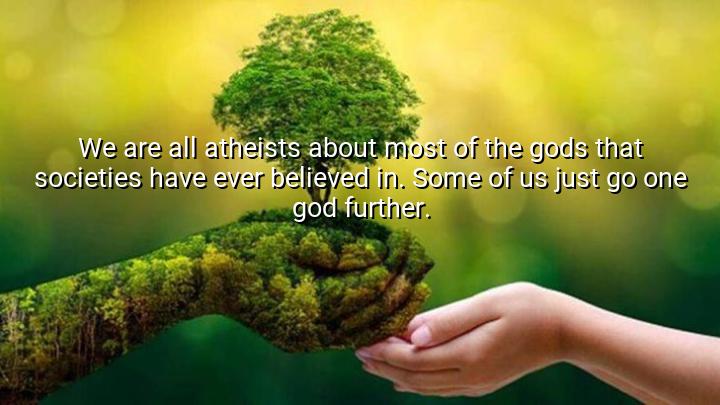




The quote by Richard Dawkins, "We are all atheists about most of the gods that societies have ever believed in. Some of us just go one god further," reflects his perspective on atheism and the nature of belief in gods. Dawkins suggests that people who identify with a particular religion are, in essence, already atheists regarding the multitude of gods worshipped by various cultures throughout history. They do not believe in those deities, just as atheists do not believe in their own god. The only difference, according to Dawkins, is that atheists simply extend their disbelief to include one more god—the one worshipped in their own religion.
This idea challenges the concept of faith and highlights the subjectivity of belief. Dawkins is pointing out that faith in any particular god is often culturally specific, and people’s belief in a deity is influenced by their upbringing, society, and environment. By comparing religious beliefs to atheism, he suggests that belief in gods is a human construct, and our rejection of one god is no different from rejecting another. The quote reflects his skeptical stance toward religion and supports the idea that reason and evidence should guide beliefs rather than tradition or inherited faith.
The origin of this quote comes from Richard Dawkins, a prominent evolutionary biologist and outspoken critic of religion. Known for his book "The God Delusion", where he explores his atheist views and critiques the existence of God, Dawkins often uses similar arguments to challenge traditional religious belief systems. His work focuses on the scientific and rational worldview, and this quote succinctly encapsulates his approach to religious belief, suggesting that people are selectively atheistic depending on which gods they choose to reject.
Ultimately, the quote emphasizes rationalism and critical thinking in the face of religious belief. It encourages individuals to question the gods they believe in, just as they would question other myths or ideas that have been accepted throughout history. Dawkins' perspective challenges the privileged status of any religion and invites people to examine their beliefs with the same skepticism they would apply to other superstitions or unproven claims.

AAdministratorAdministrator
Welcome, honored guests. Please leave a comment, we will respond soon