

Isn't it sad to go to your grave without ever wondering why you were born? Who, with such a thought, would not spring from bed, eager to resume discovering the world and rejoicing to be part of it?
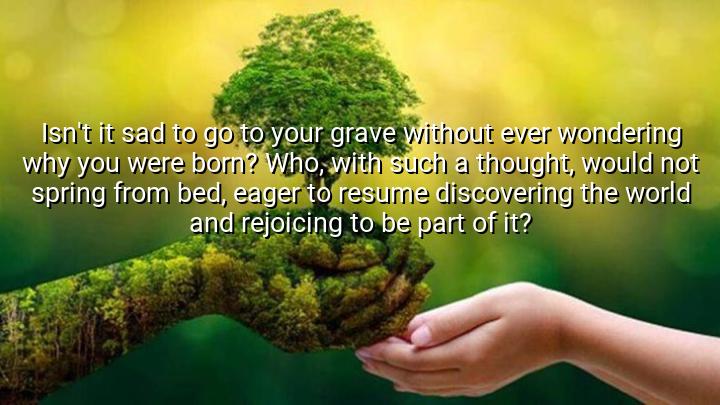




Richard Dawkins' quote, "Isn't it sad to go to your grave without ever wondering why you were born? Who, with such a thought, would not spring from bed, eager to resume discovering the world and rejoicing to be part of it?" reflects his belief in the importance of curiosity and the search for meaning in life. The first part of the quote emphasizes the sadness of living a life without ever questioning one's purpose or existence. According to Dawkins, the act of wondering about our reason for being alive is fundamental to living a fulfilled, engaged life. Without that self-reflection, life becomes a mechanical routine, lacking deeper meaning or direction.
The origin of this quote lies in Dawkins' overarching philosophy as a scientist and evolutionary biologist, where he often discusses the significance of understanding the natural world and our place within it. This curiosity about the universe, and specifically about human existence, is something that he believes should drive us to continually learn and grow. His question challenges us to consider our existence and the mystery of life, suggesting that this reflection should fuel our passion to explore and celebrate the world around us.
The second part of the quote—"Who, with such a thought, would not spring from bed, eager to resume discovering the world and rejoicing to be part of it?"—captures Dawkins' view that acknowledging the profound nature of our existence should ignite a sense of wonder and excitement. Instead of succumbing to routine or passivity, the recognition of the gift of life should motivate us to engage actively with the world, always seeking new discoveries and embracing the joy of being alive.
Dawkins’ philosophy often merges science and humanism, advocating for a life rich in inquiry and exploration. His words serve as an invitation to embrace life with enthusiasm and a commitment to questioning the world around us. It’s a call to not simply exist but to live deliberately, always seeking meaning, growth, and understanding.

AAdministratorAdministrator
Welcome, honored guests. Please leave a comment, we will respond soon