

There may be fairies at the bottom of the garden. There is no evidence for it, but you can't prove that there aren't any, so shouldn't we be agnostic with respect to fairies?
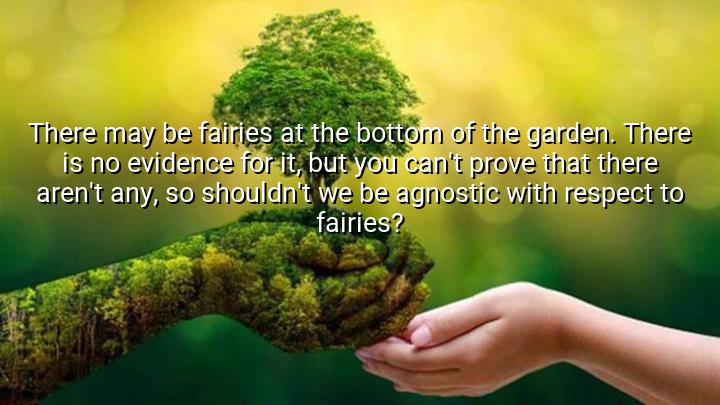




Richard Dawkins’ quote, “There may be fairies at the bottom of the garden. There is no evidence for it, but you can't prove that there aren't any, so shouldn't we be agnostic with respect to fairies?” illustrates his perspective on agnosticism and evidence in relation to beliefs. Dawkins uses the hypothetical idea of fairies as a metaphor for supernatural claims or ideas that lack empirical evidence. He argues that while there is no proof of such beings, the absence of evidence doesn't automatically prove their non-existence, leading to an agnostic stance on claims without evidence.
The origin of this quote can be found in Dawkins' broader philosophy and critique of religion and supernatural beliefs. As an evolutionary biologist and a prominent atheist, Dawkins often emphasizes the importance of evidence-based reasoning and the scientific method. This quote, drawn from his writings and public speeches, is an example of how he uses humor and irony to challenge the acceptance of ideas that are not grounded in evidence. In the case of the fairies, he points out that just because something cannot be disproven doesn't mean it deserves equal consideration without evidence.
Dawkins also uses this quote to critique agnosticism in the context of religious beliefs. He highlights the flaw in claiming that one should remain agnostic about all supernatural ideas simply because they can't be disproven. By invoking fairies, he is suggesting that agnosticism should not be applied indiscriminately to all claims, especially those that lack empirical evidence. The core of his argument is that agnosticism should be reserved for genuine uncertainties, not for hypothetical scenarios with no supporting evidence.
Ultimately, this quote encourages a critical examination of how we approach claims about the supernatural and unknown. Dawkins advocates for a rational approach to belief, suggesting that it’s more reasonable to reserve belief and certainty for ideas that are backed by evidence. In doing so, he challenges the tendency to accept unproven ideas simply because they cannot be disproven, urging a more thoughtful and skeptical approach to all forms of knowledge and belief.

AAdministratorAdministrator
Welcome, honored guests. Please leave a comment, we will respond soon