

Two races share today the soil of Canada. These people had not always been friends. But I hasten to say it. There is no longer any family here but the human family. It matters not the language people speak, or the altars at which they kneel.
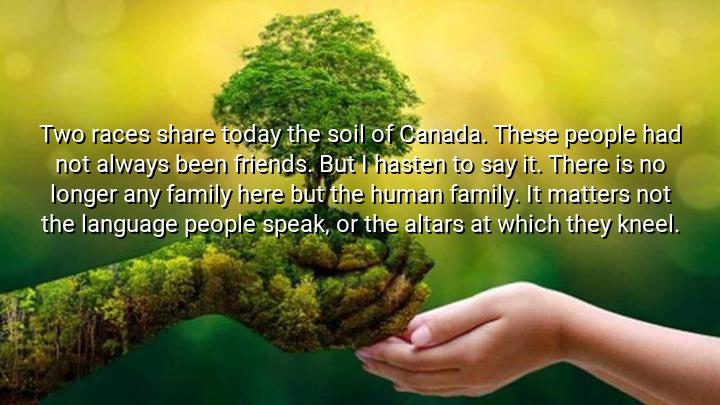




The quote “Two races share today the soil of Canada. These people had not always been friends. But I hasten to say it. There is no longer any family here but the human family. It matters not the language people speak, or the altars at which they kneel.” by Wilfrid Laurier reflects a vision of unity, reconciliation, and inclusivity in the context of Canadian history. Laurier emphasizes that although two races—primarily English and French Canadians—once faced conflict and division, they now belong to a single human family, transcending cultural and religious differences. By declaring that it “matters not the language people speak, or the altars at which they kneel,” he affirms that diversity of language and faith should not divide a nation.
The origin of this quote lies in Wilfrid Laurier’s tenure as the seventh Prime Minister of Canada (1896–1911), during a period when the country was navigating tensions between French and English populations. Canada’s dual heritage often led to political and social friction, particularly concerning language, religion, and governance. Laurier, known for his conciliatory and unifying approach, frequently spoke about national harmony and the bridging of cultural divides. This statement embodies his belief that national identity must rise above ethnic or religious loyalties to embrace a shared humanity.
This quote also serves as a philosophical reflection on nation-building. By framing Canada as part of the human family, Laurier connects national unity to universal human values, suggesting that peace and cooperation come from mutual respect rather than assimilation. His words carry a timeless message: a successful society is one where differences in language, culture, and religion are respected but do not divide the collective spirit.
Ultimately, Laurier’s words are a call for inclusivity and shared purpose. They remind Canadians—and humanity at large—that lasting unity is built not on erasing differences, but on embracing diversity as part of a greater human family. His vision captures the ideal of multicultural harmony, making the quote relevant beyond its historical context as a universal statement on coexistence and tolerance.

AAdministratorAdministrator
Welcome, honored guests. Please leave a comment, we will respond soon