

To Barack Obama, if you believe in traditional marriage, you are a homophobe. If you believe men shouldn't go into women's bathrooms and showers, you are a bigot. If you believe the unborn have a right to life, you must hate women.
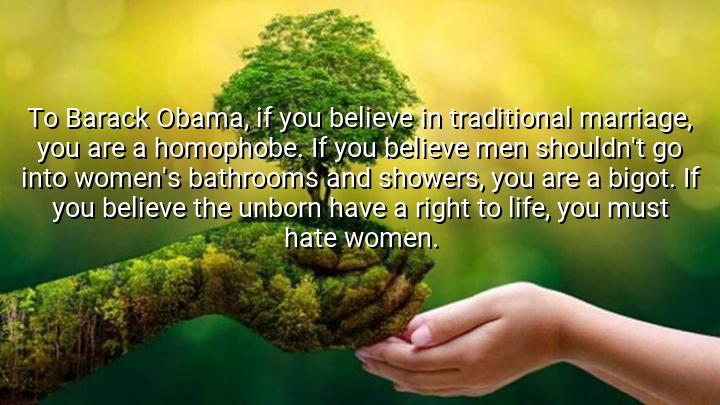




Robert Jeffress’s quote criticizes the way certain values and beliefs are framed in modern political discourse, particularly in relation to former President Barack Obama's policies. He suggests that, under Obama’s leadership, people who uphold traditional marriage, believe that men shouldn't go into women's bathrooms, or oppose abortion (believing that the unborn have a right to life) are often labeled as homophobic, bigoted, or even as hating women. Jeffress’s statement is an assertion about how certain conservative views are unfairly vilified in contemporary society, particularly within the context of political correctness and the push for more inclusive policies.
The origin of this quote comes from Robert Jeffress, a prominent Dallas-based pastor and political commentator known for his strong conservative views. As a frequent supporter of Christian conservative values, Jeffress has often voiced criticism of what he perceives as the liberal agenda's efforts to marginalize individuals with more traditional, religious perspectives. His statement here reflects his belief that conservatives, particularly in the context of family values, religious freedom, and pro-life stances, are being unfairly demonized in mainstream discourse.
In this quote, Jeffress is highlighting a growing division between conservative and liberal ideologies, particularly in the context of social issues. He feels that those who align with more traditional views on marriage, gender, and life are being labeled as intolerant or uncompassionate when their beliefs conflict with the progressive movement’s goals. This sentiment speaks to the cultural and political battles over values, with Jeffress suggesting that such individuals are being unjustly targeted for holding positions that they see as part of their moral or religious convictions.
Ultimately, Robert Jeffress’s quote addresses the polarization in political and cultural debates surrounding issues like marriage equality, gender rights, and abortion. By framing these issues in stark terms, Jeffress highlights what he views as a bias against conservative values in public discourse, particularly in a time when these values seem increasingly at odds with the dominant liberal ideology in the U.S. His words reflect a broader concern about the labeling of individuals who hold traditional beliefs, calling attention to the cultural divide that continues to shape modern political debates.

AAdministratorAdministrator
Welcome, honored guests. Please leave a comment, we will respond soon