

The fact that what we believe about marriage - that it should be between a man and a woman - and that we're pro-life, somehow that becomes radical? Why is that? It's because our culture has changed. But the truth is, culture may change, people change, but the Word of God never changes, and that's what we rest our belief system on.
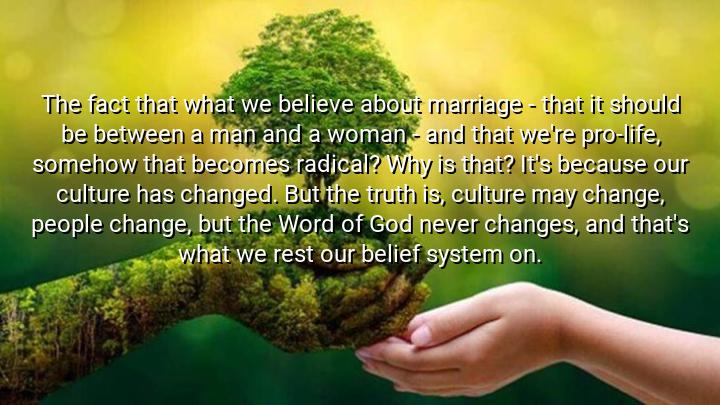




Robert Jeffress’s quote reflects his belief in the traditional definition of marriage as being between a man and a woman, as well as his pro-life stance on issues such as abortion. He questions why these positions are now considered radical by some, attributing this shift to changes in culture. Jeffress suggests that while culture may evolve and people may change their views, his faith is rooted in the Word of God, which he believes remains constant and unchanging. This reliance on religious doctrine informs his views on marriage, life, and other social issues.
The origin of this quote can be traced to Robert Jeffress’s role as a prominent Christian pastor and religious commentator, particularly within the context of his work at First Baptist Church in Dallas, Texas. Jeffress is known for his outspoken views on moral and social issues from a Christian perspective, often emphasizing the importance of adhering to biblical principles in both personal and public life. His comments here reflect his commitment to the idea that faith and biblical teachings should serve as the foundation for one’s beliefs, especially in the face of changing social norms.
Jeffress’s statement also touches on the ongoing debate about the influence of religion in modern society, particularly as it relates to topics such as same-sex marriage and abortion rights. He implies that the increasing acceptance of alternative views on marriage and life in contemporary culture has made his traditional views seem extreme, even though he believes they are consistent with Christian teachings. For him, the Word of God offers an unwavering standard by which he measures his beliefs, and this forms the basis of his response to societal changes.
Ultimately, Jeffress’s quote emphasizes the tension between traditional religious values and the evolving norms of modern society. By asserting that culture may change but that the Word of God remains unchanged, he reaffirms his commitment to religious doctrine as the guiding principle of his worldview. His remarks speak to the broader conversation about the role of faith in shaping moral and political beliefs, particularly in the face of shifting cultural attitudes.

AAdministratorAdministrator
Welcome, honored guests. Please leave a comment, we will respond soon