

There is but one law for all, namely that law which governs all law, the law of our Creator, the law of humanity, justice, equity - the law of nature and of nations.
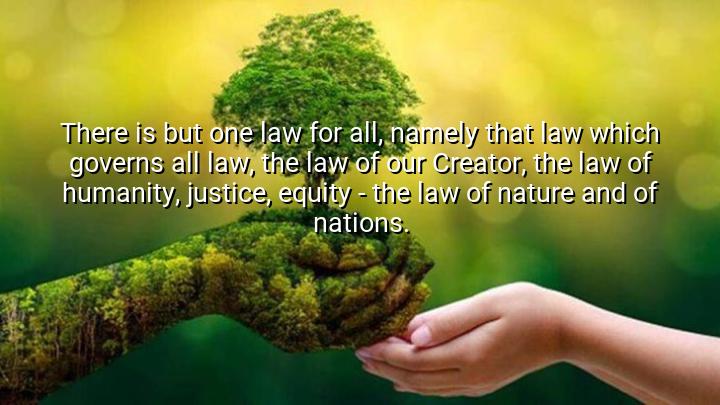




The quote by Edmund Burke, “There is but one law for all, namely that law which governs all law, the law of our Creator, the law of humanity, justice, equity—the law of nature and of nations,” emphasizes the universal principles of justice and morality that underpin all legal systems. Burke, an 18th-century Irish statesman and political philosopher, suggests that true law is not merely a set of rules created by humans but is rooted in divine, ethical, and natural principles that apply to all people equally.
The meaning of the quote revolves around the idea that laws should reflect higher moral standards, such as justice, equity, and the common good. Burke argues that legal systems gain legitimacy when they align with these universal principles, rather than serving only the interests of specific rulers or groups. It highlights the necessity of ethics and humanity in shaping laws and governing societies.
The origin of the quote comes from Burke’s writings on political philosophy, law, and governance, where he frequently explored the tension between human legislation and universal moral principles. As a thinker deeply concerned with both practical governance and philosophical morality, Burke often emphasized that laws should be consistent with natural rights, human dignity, and the broader principles that transcend individual societies.
Overall, the quote serves as a reminder that legitimacy in law stems from universal justice and equity. Burke underscores that all legal systems should be guided by fundamental moral and ethical principles, reflecting both the law of nature and the law of nations, ensuring fairness, accountability, and respect for human rights.

AAdministratorAdministrator
Welcome, honored guests. Please leave a comment, we will respond soon