

Religion is essentially the art and the theory of the remaking of man. Man is not a finished creation.
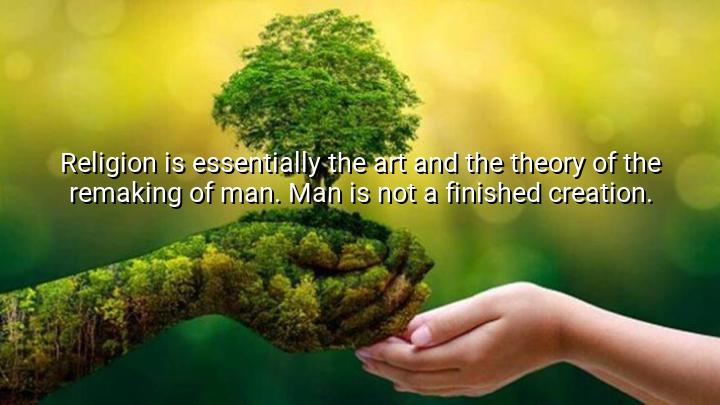




The quote "Religion is essentially the art and the theory of the remaking of man. Man is not a finished creation," attributed to the Irish political philosopher Edmund Burke, explores the transformative power of religion. Burke suggests that religion is not merely a set of doctrines or rituals, but a profound and ongoing process that works to shape, guide, and refine human nature. Religion, in this sense, plays an active role in human development, aiming to bring about an inner transformation that aligns individuals with higher moral or spiritual truths.
By describing religion as an art and a theory, Burke implies that it is both a practical discipline and a guiding framework that addresses the human condition. The term "art" suggests that religion involves a creative, dynamic process of personal growth and self-improvement, while "theory" points to the deeper philosophical and theological foundations that inform this process. Burke views religion as essential in helping individuals evolve toward their highest potential, implying that humanity is in a constant state of becoming, rather than being a finished or static creation.
The idea that man is not a finished creation underscores Burke's belief in the potential for change and moral growth. He challenges the notion that humans are born with a fixed nature, instead suggesting that individuals have the capacity to grow, evolve, and transform through religion and its moral teachings. This perspective aligns with Burke's larger philosophical views on society and tradition, where he believed that institutions, including religious ones, played a crucial role in guiding individuals toward virtuous and socially responsible lives.
Ultimately, Burke's quote emphasizes the ongoing nature of personal and spiritual development. Religion, in his view, is a means by which individuals can continually remake themselves, striving for greater moral integrity, wisdom, and alignment with divine principles. It highlights the importance of self-improvement and the belief that humanity is a work in progress, capable of profound change and evolution through spiritual and moral reflection.

AAdministratorAdministrator
Welcome, honored guests. Please leave a comment, we will respond soon