

The Western day is indeed nearing when the inner science of self-control will be found as necessary as the outer conquest of nature. This new Atomic Age will see men's minds sobered and broadened by the now scientifically indisputable truth that matter is in reality a concentrate of energy.
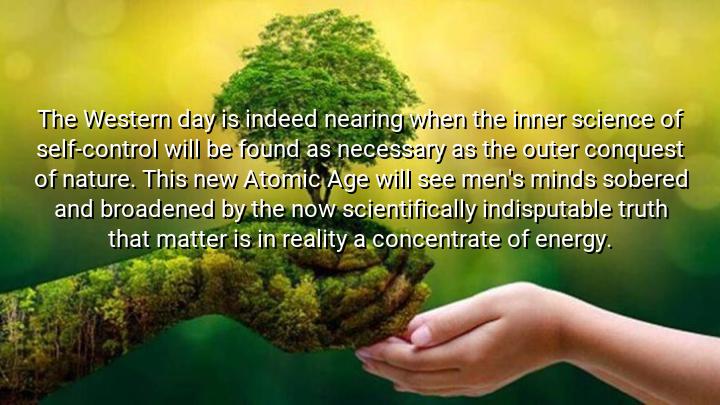




Paramahansa Yogananda’s quote, "The Western day is indeed nearing when the inner science of self-control will be found as necessary as the outer conquest of nature. This new Atomic Age will see men's minds sobered and broadened by the now scientifically indisputable truth that matter is in reality a concentrate of energy," suggests a future where inner and outer mastery are equally important for human progress. Yogananda predicts that as science and technology advance, particularly with the discovery of atomic energy, there will be a greater recognition of the need for self-control and inner growth to balance the external achievements of humankind.
The quote highlights the evolving role of self-control in modern life, asserting that as humanity becomes more capable of dominating nature through scientific and technological advancements, it will also need to focus on mastering the mind and emotions. Yogananda sees this as a necessary counterpart to external conquest, where the true power lies not only in our ability to manipulate the world but also in our ability to discipline our inner selves. This reflects his belief in the integration of spirituality and science, where understanding and controlling the mind is essential for a balanced, harmonious life.
Yogananda, a prominent Indian spiritual teacher and yogi, introduced many aspects of Eastern spiritual wisdom to the West, particularly focusing on meditation and self-realization. His teachings often emphasized the connection between science and spirituality, believing that self-control and inner development were vital for achieving a deeper understanding of reality. This quote reflects his broader philosophy that modern advancements in science and technology should be complemented by spiritual growth and mental discipline.
In essence, Yogananda’s quote stresses that the future of humanity lies not only in external progress but in the evolution of inner awareness and control. As scientific discoveries, like the understanding of atomic energy, continue to reshape society, so too must individuals develop their capacity for self-control to navigate this new era. Yogananda’s vision integrates the material with the spiritual, calling for a balance between conquering nature and mastering the self.

VNVinh Nguyen
What strikes me is the implicit warning in this quote. We’ve conquered nature in so many ways—technology, industry, even space—but have we conquered ourselves? Self-control isn’t really celebrated in modern Western culture the way innovation and consumption are. Should it be? How can we make emotional intelligence and inner mastery as culturally valued as scientific achievement? It feels like our next evolutionary step is psychological, not technological.
HDhongdao dang
This quote touches on a fascinating intersection of quantum physics and Eastern philosophy. The idea that matter is just energy mirrors both scientific discoveries and ancient teachings. But I’m left wondering: how can this insight practically change how we live? If everything is energy, should that affect our ethics, our relationships, our sense of purpose? And what would a society look like that truly believed and acted on this realization?
PDLo Thi Phan Diep
Yogananda’s words make me feel both hopeful and uneasy. On one hand, I admire the vision that people might evolve beyond pure materialism into deeper self-awareness. But on the other, I question if society—especially in the West—is really moving in that direction. Is our obsession with speed, consumption, and productivity actually pulling us away from the kind of self-control he’s advocating for? How do we shift our priorities in time?
UGUser Google
I find this quote profound and a bit prophetic. The idea that science and spirituality aren't opposed, but rather complementary, really resonates. It makes me wonder if more people in the West are starting to embrace introspective practices like meditation and mindfulness because they sense this need. Could our survival in the modern age actually depend on emotional regulation and inner mastery as much as scientific advancement?
THTrieu Thi Hanh
This quote gives me a lot to think about. It seems like Yogananda is calling for a balance between technological progress and inner spiritual growth. I agree that in an age of rapid scientific discovery—especially things like atomic energy—we also need to cultivate self-awareness and responsibility. But are we actually doing that as a society? Has our moral maturity kept pace with our technological power, or are we heading for imbalance and disaster?