

The Scottish desire for independence is, to some extent, a fabrication. They want to identify themselves as Scots but still to be part of a, to enjoy the subsidy they get from being part of the kingdom.
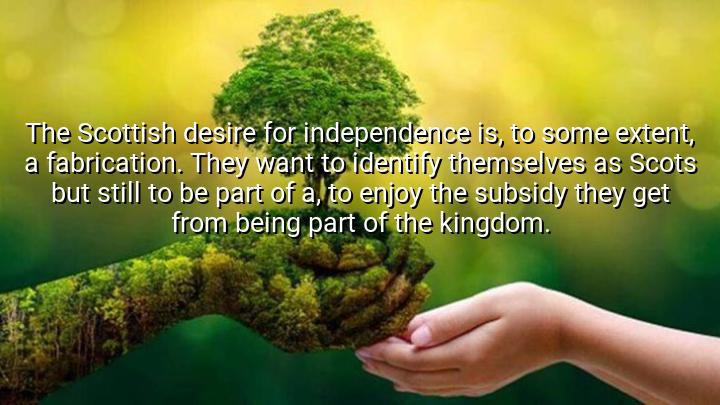




Roger Scruton's quote suggests that the Scottish desire for independence may not be entirely genuine or consistent. He argues that while many Scots may express a desire to identify as distinct, autonomous people, they still benefit from being part of the United Kingdom. Scruton implies that this desire for independence is complicated by the economic and social advantages that come with remaining within the UK, such as financial subsidies and other forms of support from the British government.
The origin of this statement likely stems from Scruton's broader perspective on political movements and national identity. As a conservative thinker, he often critiqued nationalism and the inconsistencies within movements that seek separation while still enjoying the benefits of the larger union. His view on the Scottish independence movement suggests a contradiction, where the desire for self-rule may be tempered by the practical realities of remaining financially intertwined with the UK.
Scruton’s point also highlights the tension between national identity and economic dependence. While many Scots identify as Scots and feel a strong cultural connection to their heritage, the financial support and resources that come from being part of the UK may make true independence less appealing. He seems to suggest that the Scottish desire for autonomy may not be as resolute as it appears, as people may be reluctant to give up the financial security that comes with the UK’s subsidies.
Ultimately, Scruton’s quote reflects a critique of the Scottish independence movement, questioning whether it is motivated by true nationalistic fervor or if it is more about asserting a cultural identity while still benefiting from the economic support that comes with being part of the UK. It raises questions about the authenticity of the call for self-determination when there are significant benefits to remaining within the union.

AAdministratorAdministrator
Welcome, honored guests. Please leave a comment, we will respond soon