

My main argument is that environmental destruction comes when people externalise their costs and pass them on to future generations. That is obviously something that large enterprises do and they become large by doing it.
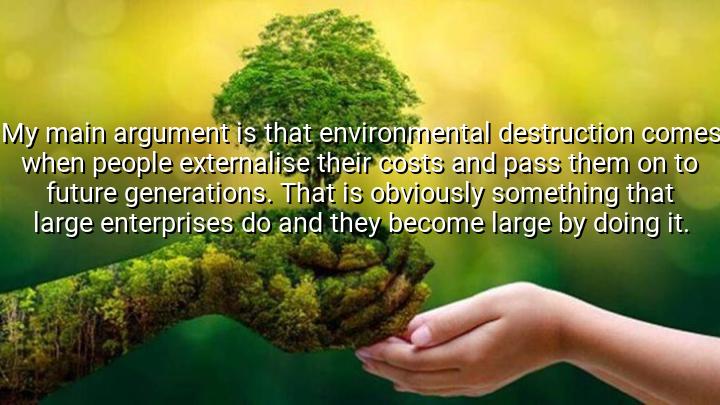




In this quote, Roger Scruton, a British philosopher and writer, argues that environmental destruction often occurs when individuals or enterprises externalize their costs, meaning they shift the negative consequences of their actions onto others, particularly future generations. He suggests that many large enterprises grow by taking advantage of this practice, where they avoid paying the full cost of their environmental impact, such as pollution or resource depletion. Instead of internalizing these costs, they pass them on to society at large, including the generations yet to come, who will bear the consequences.
Scruton’s point highlights the unsustainable nature of such practices, where short-term economic growth is prioritized over long-term environmental sustainability. By externalizing their costs, companies can continue to profit in the present, but at the expense of environmental health and social well-being in the future. This kind of economic model ignores the ethical responsibility of businesses to account for the long-term effects of their actions, and leads to environmental degradation that will impact future generations.
The quote also critiques the idea that large enterprises often become successful by exploiting externalities, a concept in economics where the full costs of their actions are not reflected in their prices. Scruton implies that capitalism, in its current form, can incentivize businesses to neglect the environmental costs of their production and operations. This neglect not only harms the environment but also puts an ethical burden on future generations, who will face the consequences of today’s unsustainable practices.
The origin of this quote reflects Scruton’s philosophical and conservative perspective on both environmental issues and capitalism. Known for his work on conservation, environmental ethics, and political philosophy, Scruton frequently critiqued modern economic systems that he believed failed to account for long-term sustainability and the moral implications of environmental destruction. This quote is part of his broader argument that society must find ways to balance economic development with environmental responsibility.

AAdministratorAdministrator
Welcome, honored guests. Please leave a comment, we will respond soon